

The Missouri Barndominium
Septic Survival Guide
Building outside city limits means you become your own wastewater treatment facility. Here's the exact roadmap, plus county-by-county contacts for all 114 Missouri counties.
“Septic kills more rural deals than bad credit. The system isn't hard to install. Deals die because buyers finalize their site plan, pour the foundation, and then discover their soil won't perk. The test costs $400. Moving a foundation costs $40,000. Test the dirt first. Every single time.”
John Piazza Norton, Founder, DreamStart Building Company
Building outside city limits means you are your own wastewater facility. Missouri's 3-acre state exemption sounds like a free pass, but it isn't. Lenders will require a compliant system regardless of acreage, and some Missouri counties (Jefferson and Boone, for example) permit every system regardless of lot size. The order of operations matters: get the soil test before you finalize your site plan, not after. Use our county finder below to see your county's regulatory stance and health department contact before you break ground.
1. It All Starts with the Dirt: The Soil Morphology Test
Before you can finalize your house plans, you need to know what the ground can handle. You cannot guess, and you cannot afford to be wrong.
Commonly called a "perc test," a soil morphology evaluation must be performed by a state-registered evaluator. They dig test pits to analyze soil type, bedrock depth, and water table levels. The results of this test legally dictate exactly which kind of system you are allowed to install.
If the soil has too much clay or rock, water won't drain and a conventional system will fail. Missouri's rocky Ozarks terrain and heavy northwest Missouri clay soils make this step non-negotiable. The test costs $300 to $500. Getting it wrong after you've broken ground costs exponentially more.
What the Evaluator Checks
Soil texture and permeability (how fast water moves through)
Depth to bedrock or restrictive layer
Seasonal high water table depth
Soil color patterns indicating drainage quality
2. The 3-Acre Rule and Its Traps
Missouri law generally states that if your residential lot is 3 acres or larger, you are exempt from state septic permitting requirements. On paper, this sounds like a free pass.
The Reality Check: Two Reasons the Exemption Won't Save You
- 1. Counties override it. Some Missouri counties permit every on-site system regardless of lot size. Jefferson County, for example, told us there is no exemption for lots over 3 acres, and Boone County has no lot-size exemptions. Your parcel may be 10 acres and still need a full permit, so ask your county before you assume the exemption applies.
- 2. Your lender overrides it. If you are financing your build, your lender or appraiser will almost certainly demand proof of a compliant, professionally installed system regardless of acreage. "State exemption" is not language any bank's appraisal department accepts.
Bottom line: always design to full state standards, regardless of lot size or exemption status.
3. Choosing Your System: The Big Three
Your soil morphology report will point you toward one of three primary systems used in Missouri. Here's how they stack up:
| System Type | Best For | The Bottom Line |
|---|---|---|
| Sewage Lagoon | Large lots (3+ acres) with poor-draining soil (heavy clay) | Cost-effective and very common in Missouri, but takes up significant yard space and must be fenced. Typical NW Missouri solution. |
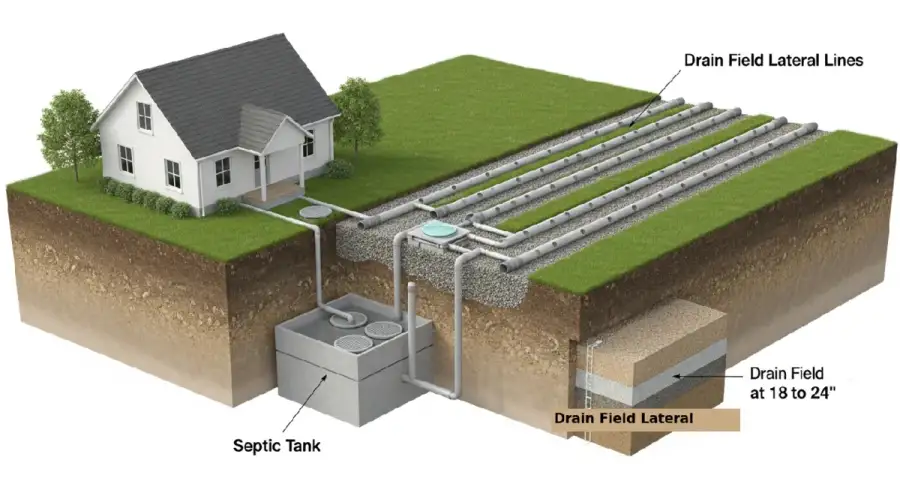
| Conventional Lateral Lines | Excellent, well-draining soil with good depth before bedrock | The traditional underground trench system. Out of sight, out of mind, but highly dependent on ideal soil conditions. |
| Aerobic Treatment Unit (ATU) | Small lots, poor soil, high water tables, or karst/rock terrain | Most expensive option. Acts like a mini municipal plant. Requires electricity and regular maintenance, but it works where nothing else can. |
4. Sizing Is About Bedrooms, Not Square Footage
One of the most common misconceptions we hear: "My barndominium is 4,000 square feet, so I need a huge septic system." That's not how it works.
Septic capacity is calculated by bedroom count, not square footage.
Missouri assumes approximately 120 gallons per bedroom per day. A 3-bedroom, 1,500 sq ft house requires the exact same septic capacity as a 3-bedroom, 4,000 sq ft barndominium.
Pro tip: If you plan to add bedrooms later (a common barndominium scenario as the shop gets converted), size the septic for your future bedroom count, not your current plans. Expanding a system after the fact is far more expensive than sizing it right the first time.
5. The Order of Operations
Follow this sequence exactly. Every step out of order creates delays and potential rework:
Get the Dirt Tested
Hire a state-registered soil morphology evaluator before finalizing your site plan or ordering your shell. This test tells you what system you can legally install and where it can go on your lot.
Design the System
Have a registered DHSS installer design the system based on your soil report and planned bedroom count. It's an engineered document, not a guess.
Secure the Permit
Submit the design to your local county health department. This is the step that determines how long the process takes: some counties take 2 weeks, some take 2 months.
Finalize the Build
Once septic is approved, you have the green light to finalize your structural placement and start moving dirt. Your shell delivery can be scheduled around this milestone.
6. Find Your County's Rules & Contacts
All 114 Missouri counties: regulatory stance, health department phone, and local system notes. Select yours to get started.
Missouri County Septic Finder
Select your county to see who issues septic permits and what we have confirmed so far.
Select your county above to see local septic rules and contacts.
State baseline: Missouri DHSS Onsite Wastewater Program · (573) 751-6095
Related Reading
Are Barndominiums Allowed in Missouri?
The complete legal guide: zoning, permitted use, and how to get your county to say yes.
Build GuideBuilding Permits for Barndominiums in Missouri
What permits you need, who issues them, and how SIP construction simplifies the inspection process.
County GuideMissouri Counties Barndominium Guide
Where you can build, county-by-county zoning overview, and P&Z contact information.
About DreamStart
We used to build barndominiums and homestead shells with our own hands, and that experience is exactly what taught us where the real value lies: in getting the design right, planning the build carefully, and working successfully alongside local builders hired by owners. That hands-on experience helps us prepare clearer planning and handoff materials, but it does not make DreamStart the party choosing your contractor. DreamStart now operates as a pre-construction planner and design advisor, not a builder, general contractor, installer, or construction manager. We produce your custom drawings and documentation, coordinate engineering only when your county or lender requires it, and guide site-readiness and logistics. DreamStart designs the plans, organizes the steps, and quotes the EPS panel price; your local builder buys the panels directly from EPS at that price and sets them. We do not self-perform or include general-contractor labor, excavation, foundations, shell erection, utilities, or finish-out. That work is performed by your local builder and trades you retain, contract, and pay directly. We help you find a general contractor and hold a three-way interview, then hand off a clear written plan. DreamStart does not perform or manage field construction; each owner independently selects, contracts, pays and schedules their contractors. Verify the GC's qualifications, insurance, permit requirements, and lender requirements with the appropriate local authorities and your lender.
Take the Next Step
Ready to Price Your Homestead Shell?
DreamStart designs the plans, organizes the steps, and quotes the EPS panel price; the local builder you hire buys the panels directly from EPS at that price and sets them. Your GC handles construction. Get your custom estimate free, no obligation.