

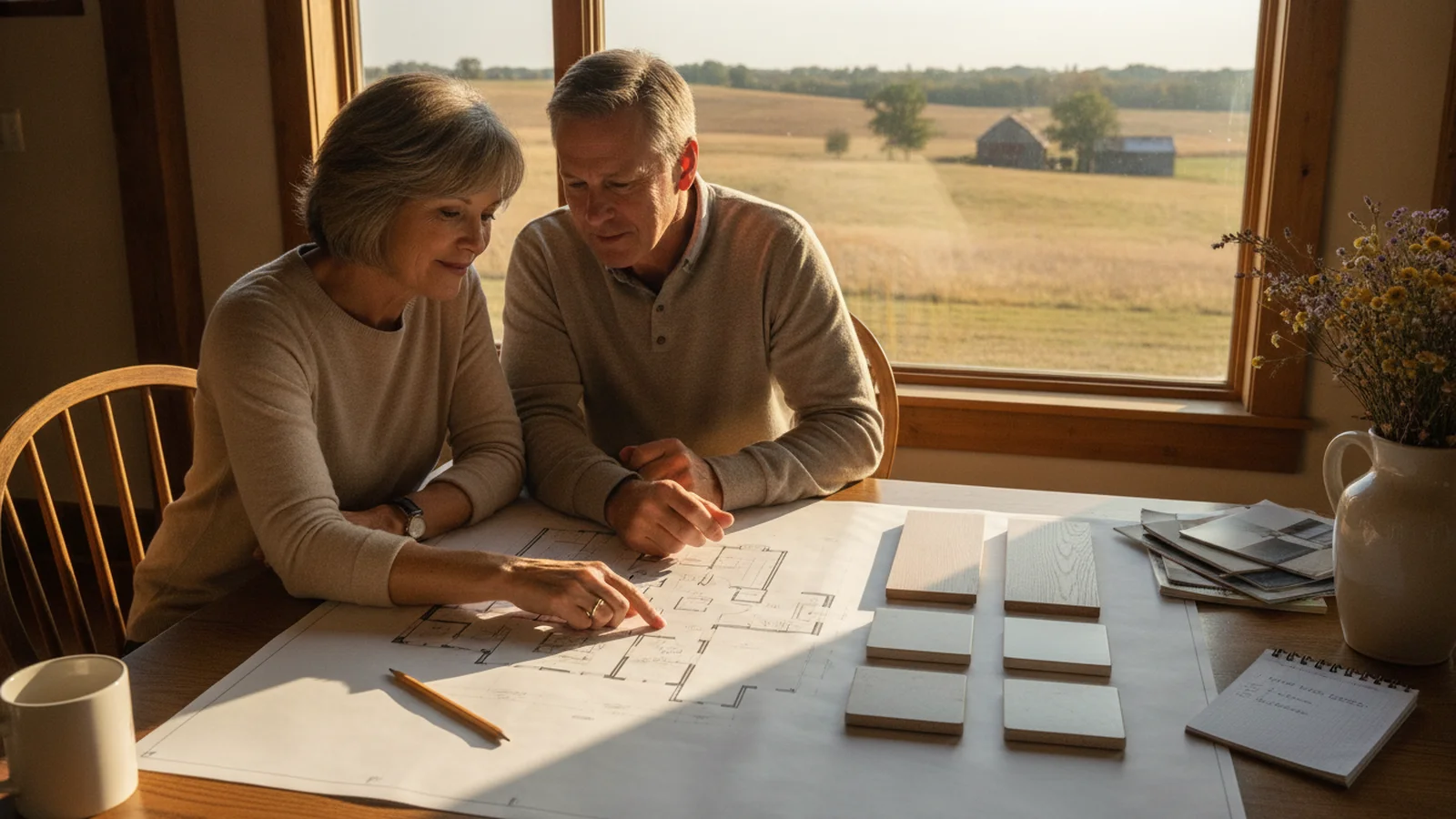
TL;DR: More options can make planning a house harder, not easier: you stall while you choose and second-guess after. Start from a proven plan, decide the big things first, write your must-haves before you shop, narrow every choice to three, and close each decision with a date.
I'm reading The Paradox of Choice by Barry Schwartz right now, and it explains something I see on almost every Planning Call. You'd think having endless options would make planning a house exciting. For a lot of people it does the opposite. Every choice opens three more, nothing feels final, and the whole project stalls.
If you've been going back and forth on floor plans, sizes, windows and finishes, you're not indecisive. You're running into a real effect that researchers have studied for decades. The good news is that it has a fix.
Why more choices make deciding harder
Schwartz's point is simple: past a certain number, more options don't make us happier. They make us more anxious while we choose and less satisfied after we do, because we keep wondering about the ones we didn't pick.
A well-known study shows it plainly. Shoppers at a grocery store saw a tasting table with either 24 jams or 6 jams. The big display drew more people to stop, but only about 3% of them bought a jar. At the small display, about 30% bought one. More choice got attention; fewer choices got decisions.
Schwartz also describes two ways people choose:
- Maximizers want the very best option, so they keep searching and comparing, and they often feel worse about what they finally pick.
- Satisficers set a clear standard for "good enough," pick the first option that meets it, and move on. They tend to be happier with the result.
Planning a house turns almost anyone into a maximizer. It's the biggest purchase most of us ever make, and there's always one more plan to look at.
Where it shows up when you plan a home
- Floor plans: there are thousands online, and every one gets something right and something wrong.
- Size: 1,500 square feet or 1,800? Every 100 feet changes the price and the layout.
- Layout details: the island, the pantry, a third bedroom or an office.
- Windows and doors: how many, how big, which wall.
- Finishes: flooring, counters, cabinets, fixtures, paint. This is where the choices multiply fastest.
Each one is a reasonable thing to think about. All of them at once, with no order, is how good projects stall for a year.
Five ways to decide and stay decided
1. Start from a proven plan, not a blank page
A blank page has infinite options. A proven single-level design has already solved the hard parts: the flow from the garage to the kitchen, hallway widths, where the laundry goes, a no-step entry. Start with the one that's closest, then change only what matters to you. You're choosing among a few good options instead of all possible ones.
2. Decide in the right order
Some decisions get locked early and are expensive to change later. Others can wait until the house is going up. Make the big ones first and give yourself permission to ignore the small ones until their turn comes.
Decide early:
- Size and footprint
- Room layout and walls
- Where the plumbing goes (it's set in the slab)
- Window and door openings (SIP panels are cut at the factory)
- Where the house sits on your land
Can wait:
- Flooring
- Cabinet style and counters
- Light fixtures and faucets
- Paint colors
- Appliances and hardware
When you're stuck on paint colors before the floor plan is final, set the paint aside. Its turn hasn't come yet.
3. Write down "good enough" before you shop
Before you look at options, write your two or three must-haves for that decision. For a kitchen it might be: an island that seats three, a walk-in pantry, and a window over the sink. Then pick the first option that meets all three and stop looking. That's how satisficers stay happy with their choices.
4. Narrow it to three
Whatever you're choosing, get it down to three options, and then choose. Three is enough to compare and few enough to decide. If a fourth shows up, it has to replace one of the three, not join them.
5. Put a date on it and close the door
Give each big decision a deadline. Once you decide, stop shopping for that item, because looking at more options after you've chosen is what feeds regret. Keep a short list of what you decided and why, so when doubt shows up at 2 AM, you can read your own reasons instead of starting over.
How we handle this at DreamStart
We built our process around fewer, better decisions:
- A short lineup of single-level designs (one story, no stairs, on a slab), so you start from a plan that already works instead of an endless catalog.
- A Planning Call where we sort out what matters most to you and what can wait.
- The $9,750 Design Package, where your chosen design is adjusted to your land and your must-haves, and turned into drawings your builder can price and permit.
- Walk Your Plans, where you walk your floor plan at full size before anything is ordered. Feeling the real size of a room settles questions that drawings can't, and it's the last stop for big changes. After that, the big decisions are done.
You don't have to make every choice at once. You only have to make the next one.
Ready to stop going in circles?
FAQ
Is it normal to second-guess my floor plan? Yes. A home is a big, lasting decision with a lot of options, which is exactly when second-guessing is strongest. The fix is a clear order of decisions and a point where each one is closed.
What should I decide first when planning a house? Size, footprint and room layout come first, followed by plumbing locations, window and door openings, and where the house sits on your land. Finishes like flooring, counters and paint can wait until later in the build.
Can I change my plan after I decide? Yes, up to a point. Changes are easy on paper and at Walk Your Plans. Once the slab is poured and the panels are ordered, moving walls, plumbing or openings gets expensive, so we make those changes before that point.
Sources
- Barry Schwartz, The Paradox of Choice: Why More Is Less (Ecco, 2004).
- Sheena S. Iyengar and Mark R. Lepper, "When Choice Is Demotivating: Can One Desire Too Much of a Good Thing?" Journal of Personality and Social Psychology 79, no. 6 (2000): 995–1006. doi.org/10.1037/0022-3514.79.6.995