

SIPs vs. Stick-Built: The 2026 Missouri Showdown
Factory-cut SIP panels can shorten shell assembly compared with many stick-framing workflows. Actual field schedules depend on the site, project scope, weather, and the local builder you hire.
SIPs win on every meaningful metric for a Midwest homestead shell: about 45 to 55% less framing time (RS Means), about 15 times less air leakage in an Oak Ridge test, far less construction waste, and a factory-square shell from day one. The only column where stick-built looks better is the upfront material quote, and that gap closes the moment you add framing labor.
In the red corner: stick-frame construction, the reigning champion for over a century. In the blue corner: Structural Insulated Panels, the precision-engineered challenger. This round-by-round comparison examines the data behind each option for Missouri in 2026.
Speed to Dry-In
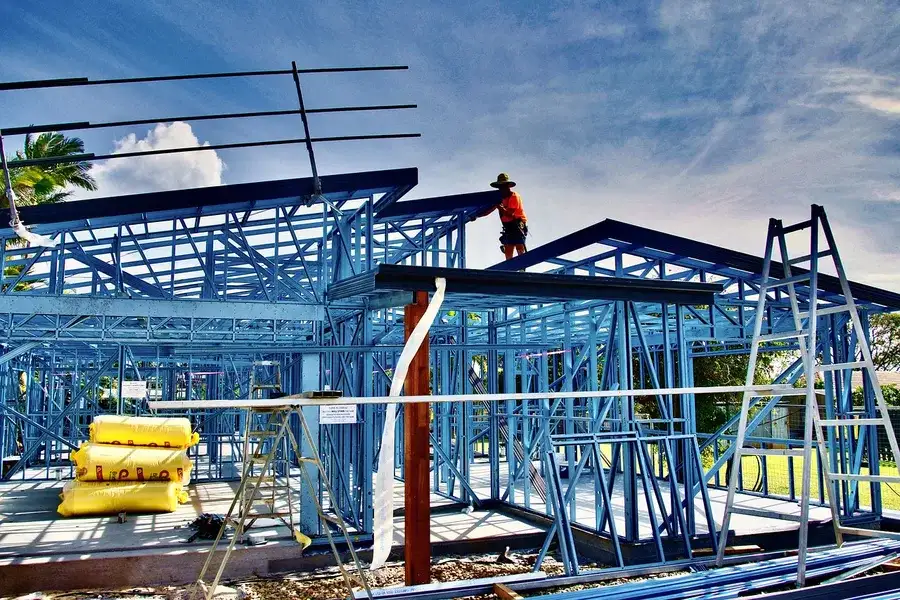
Framing crew alone. Then a separate insulation crew. Then sheathing. Each one scheduled independently, each one a delay risk.
One crew. Factory-cut panels arrive numbered. Installation is systematic assembly, not on-site construction.
Every week your house sits open to Missouri weather, you're paying construction loan interest, risking material damage, and delaying your interior trades. SIPs eliminate weeks of that exposure.
The Thermal Bridge
A 2×6 wall with R-19 fiberglass sounds good on paper. But every stud is a thermal bridge, conducting heat straight through. About 25% of your wall is wood, not insulation, so the whole wall performs closer to R-13 or R-14.
Continuous EPS foam core, no studs breaking the insulation blanket, and about 15 times less air leakage than a 2x6 stick-framed room in an Oak Ridge National Laboratory test. It's the difference between a Yeti cooler and a cardboard box.
In Missouri, with hot humid summers and cold winters, that whole-wall R-value gap means lower energy bills every month for the life of the building.
The HERS Index
A code-minimum new home scores about HERS 100. A stick home can do better with extra attention to air sealing and insulation.
A SIP shell starts with continuous insulation and a tight envelope. An independent rater scores the finished home, and the score is certified and documentable.
A low HERS score doesn't just lower your utility bills. The U.S. Department of Energy estimates SIP homes save about 12 to 14% on energy, and the certificate puts your home's efficiency in writing for appraisers and buyers.
Construction Waste
Walk any stick-frame jobsite: a mountain of scrap 2×4s, broken OSB, cut-off ends. You paid for that lumber. You're paying to haul it to a landfill.
Panels are factory-cut for your specific plan. There is almost nothing to cut on-site. The jobsite stays clean, and you're not paying for a dumpster full of materials you bought.
On a project with $80,000 in framing materials, 12% waste is nearly $10,000 in the trash. That's real money that disappears quietly while your builder calls it 'standard practice.'
The John Piazza Norton Verdict
"I'm a skeptic. I did the research because I didn't want to believe the hype. But the math is undeniable. In 2026, labor is too expensive and energy is too volatile to build the old way."
"If you want a house that's quiet, airtight, and built with the precision of a machine, choose SIPs. Stick-building is fine if you want to follow the crowd. But if you want to beat the index and build a legacy homestead, go with the panels. Those walls work like a vault."
John Piazza Norton, DreamStart Building Company
Full Showdown Summary
| Factor | SIP Homestead Shell | Stick-Built |
|---|---|---|
| Shell assembly time | 3 to 5 days | 3 to 6 weeks |
| Wall R-value | R-26+ | R-13 to R-14 whole-wall (2x6) |
| Air leakage (ACH50) | 1.0 to 1.5 | 5 to 10 |
| Air leakage (Oak Ridge test) | About 15x less | 2x6 stick-framed room |
| Racking strength | 2 to 3× stronger (SIPA) | Baseline |
| Jobsite waste | Under 2% | 10 to 15% of material cost |
| HVAC sizing required | Smaller unit | Full-size or oversized |
| Energy savings (DOE estimate) | About 12 to 14% | Baseline |
| Long-term callbacks | Minimal | Common (air/moisture) |
| Total build time | 4 to 9 months | 9 to 12 months |
| 30-year ROI | High (utility savings + appraisal) | Baseline |
Where Stick Framing Still Makes Sense
Stick framing has real advantages when design changes happen mid-build, when the structure has highly irregular shapes or complex roof lines, or in areas with limited SIP supplier access. It's widely understood by any contractor and inspected by any inspector. For a standard barndominium or homestead shell with a defined floor plan in Missouri, SIPs win in almost every category, but it's worth knowing the exceptions.
Ready to Build Your SIP Homestead Shell?
Get a real estimate for your project in Springfield, Joplin, Jefferson City, or anywhere across Missouri.
Frequently Asked Questions
Are SIP panels better than stick framing for a barndominium?
For most barndominium builds, yes, by a significant margin. SIP framing takes about 45 to 55% less time than stick framing (RS Means), create a tighter thermal envelope (cutting energy bills), and require a smaller crew. The main consideration is that SIPs require more planning upfront since panels are factory-cut to your plan. Mid-build design changes are harder and more expensive than with stick framing.
Are SIP panel barndominiums more expensive than stick built?
The material cost per square foot is higher for SIPs, but total installed cost is often similar or lower when you account for the labor savings (an RS Means study found about 45 to 55% less framing time), a smaller HVAC unit, and very little jobsite waste. Long-term, SIP barndominiums save on energy costs every year (the U.S. Department of Energy estimates SIPs save about 12 to 14% on energy), making them dramatically cheaper over a 10 to 30 year ownership period.
How much faster is SIP construction than stick framing?
Once your site, panels and builder are in place, a SIP barndominium shell can go up in 3 to 5 days. A comparable stick-framed structure takes 3 to 6 weeks to frame, then needs a separate insulation crew. Because panels arrive factory-cut and numbered, installation is closer to assembly than construction.
Do SIP panels hold up to Missouri weather?
Better than stick framing. SIPA documents SIP walls at 2 to 3 times the racking resistance of stick-framed walls, which matters during Missouri's severe thunderstorms and straight-line wind events. The airtight envelope also handles temperature extremes far more efficiently than a leaky stick-built wall.
What is the HERS Index and why does it matter for barndominiums?
HERS (Home Energy Rating System) scores a home's energy efficiency on a scale where 100 is a code-minimum new build and lower is better. A SIP shell's continuous insulation and tight envelope give the finished home a strong head start toward a low score, and an independent rater scores the finished house. The certificate gives appraisers and lenders documented proof of efficiency.
Where does stick framing still make sense over SIP panels?
Stick framing has advantages when design changes happen mid-build, when the structure has highly irregular shapes or complex roof lines, or in areas with limited SIP supplier access. For a barndominium or homestead shell with a defined floor plan in Missouri, SIPs win in almost every category that matters.
How does Missouri clay soil affect the SIP vs. stick decision?
It doesn't directly affect the framing method, but it absolutely affects the foundation. Because SIP panels are factory-cut to the millimeter, they require a slab that's level within 1/8 of an inch. Missouri's expansive clay soil makes achieving that precision harder. You need a soil engineer and a precision concrete crew regardless of which framing method you choose, but the stakes are higher with SIPs because panel tolerances are tighter.
Related Reading
References
- U.S. Department of Energy: Building Envelope Research
- Structural Insulated Panel Association (SIPA): Strength and Performance Data
- Oak Ridge National Laboratory: Whole-Wall R-Value and Air Leakage Testing
About DreamStart
We used to build barndominiums and homestead shells with our own hands, and that experience is exactly what taught us where the real value lies: in getting the design right, planning the build carefully, and working successfully alongside local builders hired by owners. That hands-on experience helps us prepare clearer planning and handoff materials, but it does not make DreamStart the party choosing your contractor. DreamStart now operates as a pre-construction planner and design advisor, not a builder, general contractor, installer, or construction manager. We produce your custom drawings and documentation, coordinate engineering only when your county or lender requires it, and guide site-readiness and logistics. DreamStart designs the plans, organizes the steps, and quotes the EPS panel price; your local builder buys the panels directly from EPS at that price and sets them. We do not self-perform or include general-contractor labor, excavation, foundations, shell erection, utilities, or finish-out. That work is performed by your local builder and trades you retain, contract, and pay directly. We help you find a general contractor and hold a three-way interview, then hand off a clear written plan. DreamStart does not perform or manage field construction; each owner independently selects, contracts, pays and schedules their contractors. Verify the GC's qualifications, insurance, permit requirements, and lender requirements with the appropriate local authorities and your lender.
Take the Next Step
Ready to Price Your Homestead Shell?
DreamStart designs the plans, organizes the steps, and quotes the EPS panel price; the local builder you hire buys the panels directly from EPS at that price and sets them. Your GC handles construction. Get your custom estimate free, no obligation.