

Will My Barndominium Hold Its Value in Missouri?
The Appraisal Comp Problem Explained
You've found the land, chosen the floor plan, and you're ready to build. Then a lender asks the question that stops you cold: "How will it comp?" Here's the blueprint.
“The question I hear from every serious buyer is: 'What happens if I need to sell in ten years?' It's the right question. Your build is a home, and it's also the single largest financial decision of your life. The good news is the answer is simple: a SIP Homestead Shell built correctly, documented properly, and designed for maximum buyer appeal will absolutely hold and grow its value. The risk isn't the structure. The risk is not understanding how appraisers classify it.”
John Piazza Norton, Founder, DreamStart Building Company
Your barndominium will hold its value in Missouri, but only if it isn't actually a barn. The comp problem has a clear solution: engineering documentation that moves the appraisal file from 'post-frame outbuilding' to 'high-performance residential,' a single-story slab layout that appeals to the broadest buyer pool, and a HERS-certified thermal envelope that gives future buyers a monthly utility number to compare. SIP construction is what makes all three of those things possible.
1. The Banker's Blind Spot: Why Documentation Is Your Best Friend
When an appraiser pulls up to a finished home, they're operating at a fundamental disadvantage: they cannot see what's behind the metal siding. If they see a metal building, their default instinct is to classify it as a post-frame outbuilding with living quarters. That classification instantly tanks your resale value, regardless of what's actually inside.
Because a SIP Homestead Shell uses standard residential construction dimensions and structural integrity, it is a true residential home. But you have to prove it. Your paperwork is just as important as your foundation.
Your Appraisal Documentation Binder
When you hand a lender or appraiser a binder of verified documentation proving the home's thermal envelope, structural load, and residential code compliance, you move the conversation from "barn" to "high-performance green home." That documentation also opens the door to specialized green energy loans with better terms.
2. The "Forever Home" Fallacy and the Power of the Slab
Almost everyone who starts a custom build says the same thing: "This is our forever home. We're never selling." It's a beautiful sentiment. But job relocations, family emergencies, and health shifts are entirely outside your control. Since you can't predict the future, the smart move is to control what you can in the present.
To maximize resale value, you need to appeal to the widest possible range of buyers. In rural Northwest Missouri, that means two things: build on a slab, and keep the layout single-story.
No Stairs, Anywhere
No staircase to climb, carry laundry up or worry about. A zero-step ranch layout is actively sought, not just tolerated, by rural buyers.
Aging-in-Place Design
Wide doorways, a curbless shower and one-level living are features buyers actively search for in rural Missouri. Your build has them from day one.
A beautiful zero-stair single-story home on a solid slab will always command a premium in rural Missouri because demand for accessible living stays high. It's a financial strategy, not a design limitation.
3. Designing for Reality: Balancing Big Dreams with Smart Budget
When planning a barndominium, the sky feels like the limit. But what it looks like has to maintain a healthy relationship with your budget, and your future appraisal.
For example: SIP panels to a 30-foot ceiling height look incredible on Pinterest, but the engineering and material costs scale aggressively and will price out most rural Missouri buyers at resale. There are smarter ways to achieve a grand feel. Exposed, finished OSB used strategically in specific areas (while maintaining all required fire ratings) delivers the same high-ceiling aesthetic at a fraction of the cost.
At DreamStart, we stay in one or two highly refined shell configurations by design, not limitation. Standardizing the core shells keeps your equity high and your costs predictable. But custom building is a collaboration. Never hesitate to ask: "Can we try this?"
The goal is a build that feels uniquely yours while staying within the range of comps your future appraiser can actually work with. That balance is the financial sweet spot.
4. Curb Appeal Is Your Call: Ditching the Metal Mandate
There's a persistent myth that building a barndominium-style shell means you're locked into corrugated metal siding. You're not.
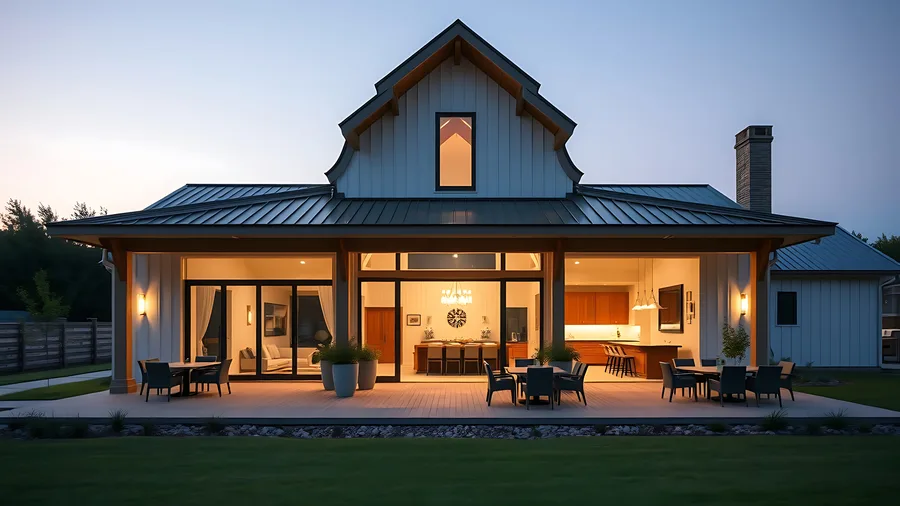
Because a SIP shell provides true, continuous structural walls, you can attach virtually any exterior finish. Lap siding? No problem. Classic brick or heavy stone accents? The structural backing supports it. Board-and-batten? That's what you're looking at in the photo above.
The exterior aesthetic is entirely your choice. You can build a home that perfectly matches your personal style while blending into the highest-priced residential comps in Northwest Missouri, which is exactly the appraisal outcome you want.
5. The Undeniable Math of Energy Bills
Long-term value isn't just about appraisal comps. It's about cost of ownership, and that's where SIP construction delivers its most concrete financial advantage.
When a potential buyer is looking at your home a decade from now, showing them utility bills lower than what a comparable standard home costs to heat through a brutal Missouri January or cool through a humid August is a massive selling point. Low cost of ownership translates directly to higher buyer demand and a stronger asking price.
That gap is a permanent competitive advantage in any resale scenario. And because it's documented with a third-party HERS certificate, it's verifiable. Buyers, appraisers, and lenders can all see it.
The Bottom Line
Your barndominium will absolutely hold its value, provided it isn't actually a barn. Focus on structural integrity, single-story slab design, documented energy efficiency, and smart exterior finishes. Control those variables and your piece of Missouri dirt will house a legacy as financially sound as it is beautiful.
Related Reading
About DreamStart
We used to build barndominiums and homestead shells with our own hands, and that experience is exactly what taught us where the real value lies: in getting the design right, planning the build carefully, and working successfully alongside local builders hired by owners. That hands-on experience helps us prepare clearer planning and handoff materials, but it does not make DreamStart the party choosing your contractor. DreamStart now operates as a pre-construction planner and design advisor, not a builder, general contractor, installer, or construction manager. We produce your custom drawings and documentation, coordinate engineering only when your county or lender requires it, and guide site-readiness and logistics. DreamStart designs the plans, organizes the steps, and quotes the EPS panel price; your local builder buys the panels directly from EPS at that price and sets them. We do not self-perform or include general-contractor labor, excavation, foundations, shell erection, utilities, or finish-out. That work is performed by your local builder and trades you retain, contract, and pay directly. We help you find a general contractor and hold a three-way interview, then hand off a clear written plan. DreamStart does not perform or manage field construction; each owner independently selects, contracts, pays and schedules their contractors. Verify the GC's qualifications, insurance, permit requirements, and lender requirements with the appropriate local authorities and your lender.
Take the Next Step
Ready to Price Your Homestead Shell?
DreamStart designs the plans, organizes the steps, and quotes the EPS panel price; the local builder you hire buys the panels directly from EPS at that price and sets them. Your GC handles construction. Get your custom estimate free, no obligation.