

Is Solar Worth It on a Barndominium? 6 Questions to Answer Before You Sign Anything
“Building from scratch gives you a massive advantage with solar — you can engineer the roof for it, orient the building for it, and size the electrical panel for it before a single nail is driven. Retrofitting solar onto an existing structure is doable but more expensive and always involves compromises.”
John Piazza Norton — Founder, DreamStart Building Company
Bottom Line Upfront
Solar on a barndominium can be excellent — but only if your co-op offers net metering, your roof is engineered for the load, and your electricity bill justifies the payback period. A SIP shell needs 20–30% fewer panels than a stick-frame house the same size. The 30% federal tax credit is real. Off-grid adds $15,000–30,000 for batteries. Ask your co-op about net metering before you call a solar company.
Solar questions come up constantly in barndominium consultations. People see the giant metal roof and immediately think "that's a lot of surface area for panels." They're right — but the decision is more complicated than roof size. There are six questions you need to answer honestly before a solar installer sets foot on your property.
These questions come from combining the most common "People Also Ask" searches around barndominium solar with the structural realities that builders actually deal with — not the sales pitch you'll get from a solar company that just wants to close a deal.
Is Your Roof Engineered for the Load?
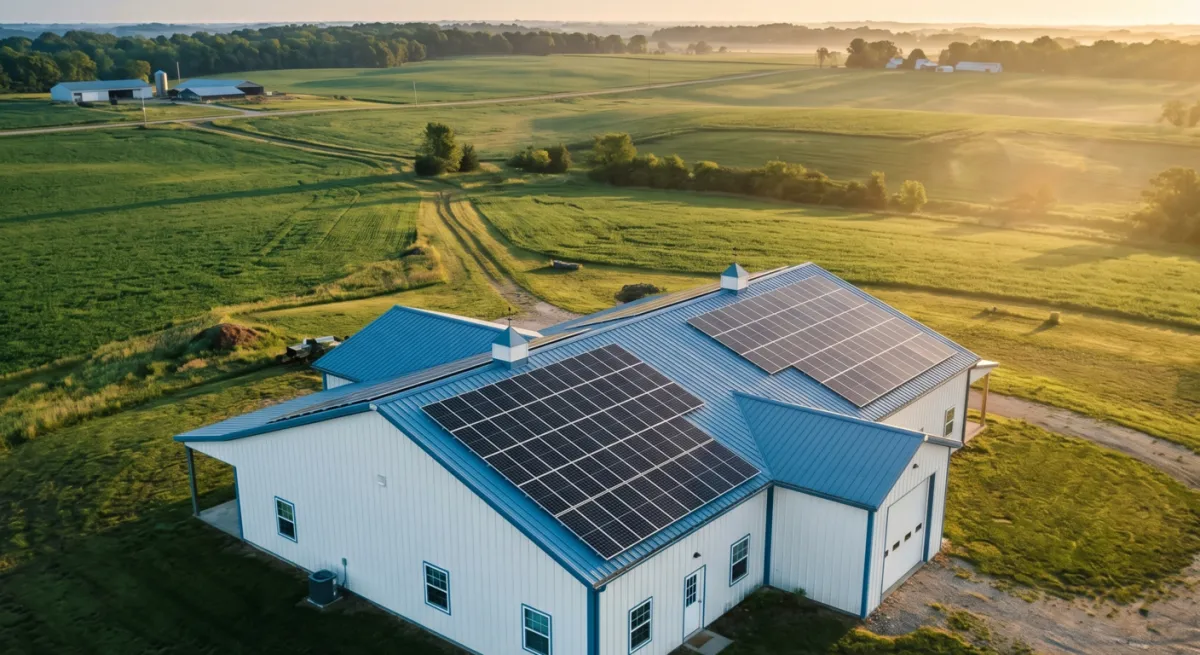
Metal roofs are excellent for solar mounting — standing seam clamps attach without penetrating the metal, which eliminates leak points entirely. But the roof structure underneath is what actually matters.
Solar panels plus racking typically add 3–4 lbs per square foot of dead load to your roof. On a 2,000 sq ft roof that's 6,000–8,000 lbs of additional weight — before wind load calculations. Your roof trusses need to be engineered to handle this, and that engineering needs to happen at the design phase, not after the shell is erected.
What to do right now
If you're in the design phase, tell your builder you're solar-curious and ask them to spec the roof trusses for a potential 4 lb/sq ft additional dead load. The cost difference is small at this stage. If your shell is already up, get a structural engineer to assess the existing trusses before any installer quotes you a job.
Ground-mount alternative: On rural acreage, a ground-mounted array on a dedicated steel structure sidesteps the roof load question entirely. You get optimal tilt and orientation, no roof penetration concerns, and easy access for maintenance. For barndominiums on 5+ acres, ground-mount deserves serious consideration regardless of roof capacity.
What Does Your Co-op Actually Pay for Excess Power?
This is the question most solar salespeople don't want to talk about. Net metering policy — whether your utility credits you at retail rate for excess solar you send to the grid — can make or break the economics of a solar system in rural Missouri.
Retail-rate net metering
Your co-op credits you at the same rate you pay for power (e.g., $0.12/kWh both ways). Payback period: typically 8–12 years after the 30% federal tax credit.
Wholesale-rate buyback
Your co-op buys your excess at wholesale ($0.03–0.05/kWh) but charges you retail. The math collapses. Payback can stretch to 18–25 years.
Missouri electric co-ops are required by state law to offer net metering, but the rates and caps vary significantly. Call your co-op's service department and ask specifically: "Do you offer net metering, what rate do you credit excess generation, and is there a system size cap?"
Also ask about your monthly electricity cost. If your current bill is under $75–100/month, the payback math gets very difficult regardless of net metering policy. Solar is most compelling when you're spending $150–300+/month on electricity.
Does Your SIP Shell Change How Many Panels You Need?
Yes — significantly. This is the part of the solar conversation that specifically matters for Homestead Shell buyers.
A typical solar installer sizes a system based on your historical energy usage. If you're replacing an existing house, they use your old bills. If you're building new, they use rule-of-thumb estimates based on square footage. The problem: those estimates assume conventional construction.
SIP vs. Stick Frame — System Size Comparison
The SIP shell's continuous foam core eliminates thermal bridging, and its airtight construction dramatically reduces HVAC load — which is typically the largest single energy draw in any home. Less load to cover means a smaller (and cheaper) solar system reaches 100% offset.
Tell any solar installer that you're building a SIP structure and ask them to model the system using a reduced load estimate. An honest installer will adjust; one who quotes you for a conventional-construction energy load is either uninformed or overselling.
What Roof Pitch and Orientation Does Solar Actually Need?
In Missouri (latitude ~38–40° N), the optimal fixed-tilt angle for solar panels is 30–40°. Most barndominium roof pitches fall between 3:12 and 6:12 (14–27°) — slightly flatter than ideal, which costs you about 5–10% in annual production. That's manageable.
Orientation matters more than pitch. South-facing roofs capture the most annual solar energy. West-facing catches afternoon peak hours (which aligns better with utility peak demand pricing, if your co-op offers time-of-use rates). East-facing or north-facing roof sections are generally not usable for solar in Missouri.
If you're still in the design phase: orient your barndominium so the long axis runs east-west, putting the largest roof section facing south. This is free to do at planning time and can make or break a future solar installation.
How Does Solar Affect Your Financing and Appraisal?
This question overlaps with the same appraisal challenges barndominiums already face — and solar adds a layer of complexity worth understanding before you finance.
Construction Loans
Most construction lenders finance the building itself, not attached equipment. Solar systems are typically financed separately — either through a solar-specific loan, a home equity product after completion, or added to a permanent mortgage if the appraised value supports it. Plan on treating solar as a separate finance conversation from your shell loan.
Appraisal
In rural markets with few comps, appraisers often struggle to assign value to solar systems. The Fannie Mae form for solar (Form 1004) exists, but appraisers need comparable sales with solar to support added value — and those comps are rare in many Missouri counties. The 30% federal tax credit (ITC) you claim personally doesn't transfer to appraised value. Budget solar as an investment in operating cost savings, not a dollar-for-dollar home value increase.
The 30% Federal Tax Credit (ITC)
This is real, substantial, and worth understanding. If you spend $40,000 on a solar system, you get a $12,000 credit against your federal tax liability — not a deduction, a credit. It applies to the year the system is placed in service. You must have sufficient tax liability to use it (or carry it forward). Consult your CPA before sizing your system around a credit you may not fully be able to use in year one.
Grid-Tied or Off-Grid — Which Makes Sense for a Rural Barndominium?
Most solar systems installed on Missouri barndominiums are grid-tied — connected to the utility grid, no batteries, with excess power exported for credit. This is the simpler, cheaper option with a faster payback.
Off-grid means adding battery storage (and often a backup generator) to be fully independent of the utility. Many rural barndominium buyers are attracted to this for self-sufficiency reasons — not purely financial ones.
Grid-Tied
- Lower upfront cost — no batteries
- Faster payback (8–12 years with net metering)
- Grid as backup — no generator needed
- Powers off during grid outages (safety rule)
- Dependent on co-op net metering policy
Off-Grid with Batteries
- Full energy independence
- Immune to grid outages
- No utility bill or net metering dependency
- Adds $15,000–30,000 for battery bank
- Payback 20+ years — primarily lifestyle decision
A middle path worth considering: grid-tied with a modest battery backup (one or two Powerwall-type units). This keeps the grid connection and net metering benefits while giving you 8–24 hours of backup power during outages. For rural Missouri where ice storms regularly knock out power for days, this is often the most practical choice.
One practical note: if you're extending the electrical grid to a remote property, get a firm quote on the utility hookup cost. Rural utility extension can run $10,000–50,000+ depending on distance and terrain. If you're already facing a $30,000 hookup fee, the off-grid calculation changes dramatically.
The Short Version
Engineer the roof for solar load during the design phase — it's cheap to add, expensive to fix later
Call your electric co-op before calling any solar company — net metering policy determines if the numbers work
A SIP Homestead Shell needs 20–30% fewer panels than stick-frame — don't let an installer size you for a leaky house
South-facing roof orientation is worth planning for even if solar is years away
The 30% federal tax credit is real — but only if you have the tax liability to use it
Grid-tied is faster payback; off-grid is a lifestyle and resilience decision with 20+ year payback
Common Questions
Is solar worth it on a barndominium?
It depends on three factors: your local utility rate and net metering policy, your roof's engineered load capacity, and whether you're in a rural area where grid reliability is poor. In Missouri, where many barndominiums are built on rural acreage served by electric co-ops, solar can make excellent sense — but only if your co-op offers net metering at retail rates. Call your co-op before designing your system.
Can you put solar panels on a metal barndominium roof?
Yes — metal standing seam roofs are actually ideal for solar. Mounting clamps attach directly to the seams without penetrating the metal, eliminating potential leak points. The key requirement is that the roof trusses are engineered for the additional dead load (typically 3–4 lbs per sq ft for panels plus racking). This needs to be specified during the design phase, not added as an afterthought.
How many solar panels does a barndominium need?
A 2,000 sq ft SIP Homestead Shell typically needs a 10–14 kW system for full offset, compared to 14–18 kW for a conventional stick-frame home of the same size. The SIP envelope's superior insulation and air-sealing dramatically reduces the energy load the solar system has to cover. Exact sizing depends on your appliances, HVAC system, and local sun hours.
Should I do roof-mount or ground-mount solar on a barndominium?
On rural acreage, ground-mount is often the better choice. You can orient the array at the optimal angle and direction regardless of roof pitch or orientation, adjust the tilt seasonally, and install on land that might otherwise be unused. Ground-mount also keeps the panels accessible for cleaning and maintenance. Roof-mount makes sense when roof orientation is ideal and you want to preserve land use.
What is the solar payback period for a barndominium in Missouri?
In Missouri with typical utility rates of $0.12–0.14/kWh and a co-op that offers retail-rate net metering, payback on a properly sized system runs 8–12 years after the 30% federal tax credit. Rural co-ops that don't offer net metering or buy excess power at wholesale rates can push payback to 15–20+ years, dramatically changing the economics.
Related Reading
Radiant Floor Heat in a Barndominium
The other big HVAC question — PEX in-floor heat, flooring compatibility, and operating cost by fuel source.
Solid-Core SIP Construction
Why the building envelope matters for energy efficiency — and why SIP shells need less HVAC and solar capacity.
Do Barndominiums Hold Their Value?
The appraisal comp problem, what drives barndominium appreciation, and how documentation affects resale.
About DreamStart
We used to build barndominiums and homestead shells with our own hands — and that experience is exactly what taught us where the real value lies: in getting the design right, planning the build carefully, and working successfully alongside local builders hired by owners. That hands-on experience helps us prepare clearer planning and handoff materials, but it does not make DreamStart the party choosing your contractor. DreamStart now operates as a pre-construction planner and design advisor — not a builder, general contractor, installer, or construction manager. We produce your custom drawings and documentation, coordinate engineering only when your county or lender requires it, and guide site-readiness and logistics. DreamStart designs the plans, organizes the steps, and gets the EPS panels ordered and delivered at the quoted package pricing for your local builder to set. We do not self-perform or include general-contractor labor, excavation, foundations, shell erection, utilities, or finish-out — that work is performed by your local builder and trades you retain, contract, and pay directly. We help you find a general contractor and hold a three-way interview, then hand off a clear written plan. DreamStart does not perform or manage field construction; each owner independently selects, contracts, pays and schedules their contractors. Verify the GC's qualifications, insurance, permit requirements, and lender requirements with the appropriate local authorities and your lender.
Take the Next Step
Ready to Price Your Homestead Shell?
DreamStart designs the plans, organizes the steps, and gets the EPS panels ordered and delivered at the quoted package pricing for the local builder you hire to set. Your GC handles construction. Get your custom estimate free, no obligation.