

Radiant Floor Heat in a Barndominium: What Works, What Doesn't, and Whether It's Worth It
“In-floor radiant is the one HVAC upgrade where the SIP shell makes you look like a genius. The building is so tight the slab stays warm for hours after the boiler cycles off. Leaky houses can't do that.”
John Piazza Norton — Founder, DreamStart Building Company
Bottom Line Upfront
In a SIP Homestead Shell in Missouri, radiant floor heat makes excellent sense. Polished concrete is the best surface — leave it and finish it. Wall-to-wall carpet kills efficiency. A propane boiler runs $150–280/month in winter. The deeper south you are, the harder the math works against it.
In-floor radiant heat comes up in almost every consultation we do. People have seen it in high-end homes, heard it's the most comfortable heat ever invented (it is), and want to know if it makes sense in a barndominium or Homestead Shell. The answer is yes — with some honest caveats about flooring, geography, and operating cost that most HVAC salespeople won't tell you upfront.
This guide covers installation considerations, long-term operating costs, flooring compatibility, and common tradeoffs for radiant floor heat.
Why SIP Shells and Radiant Heat Are a Natural Pairing
Radiant floor systems heat people and objects rather than air. That's why they feel more comfortable at lower thermostat settings — you're warm because you're being warmed directly, not because the air around you is hot. The catch is that in a leaky building, that warm air escapes constantly through gaps, and the system has to work harder to keep up.
A Solid-Core SIP shell changes the math completely. The continuous foam core eliminates thermal bridging, and the airtight construction means the heat you put into the slab stays in your living space. Your system runs at lower water temperatures — typically 90–110°F in a SIP shell versus 130–140°F in a conventional house — which means:
- Lower operating cost per hour of run time
- Longer system lifespan (lower water temps = less stress on the boiler and tubing)
- Gentler treatment of whatever flooring sits above the slab
- More stable indoor temperature — the slab acts as a thermal mass battery
In practical terms: our customers report their radiant-equipped SIP shells hold temperature for 4–6 hours after the boiler cycles off on a cold Missouri night. A stick-frame house with the same system might hold for 60–90 minutes. The building envelope is doing the work the boiler would otherwise do.
What It Actually Costs to Run
Operating cost depends almost entirely on your heat source. Here's the honest breakdown for a 2,000 sq ft SIP Homestead Shell in Missouri during peak winter months:
Electric Heat Pump Water Heater (as boiler)
Most efficient option long-term. Leverages refrigerant cycle to produce 2–3x the heat energy per dollar of electricity. Higher upfront cost ($3,000–5,000 for the unit), but operating costs rival natural gas.
Natural Gas Boiler — $110–190/month
Best choice if you have gas service. Reliable, widely serviced, and the lowest fuel cost per BTU of the conventional options. Not always available in rural Missouri.
Propane Boiler — $150–280/month
Most common choice in rural Missouri where gas service isn't available. Cost fluctuates with propane prices. Budget toward the high end in cold winters.
Electric Resistance Boiler — $300–450/month
Least expensive to install, most expensive to operate. Only makes sense if electricity is very cheap in your area (rare in Missouri) or as a backup system.
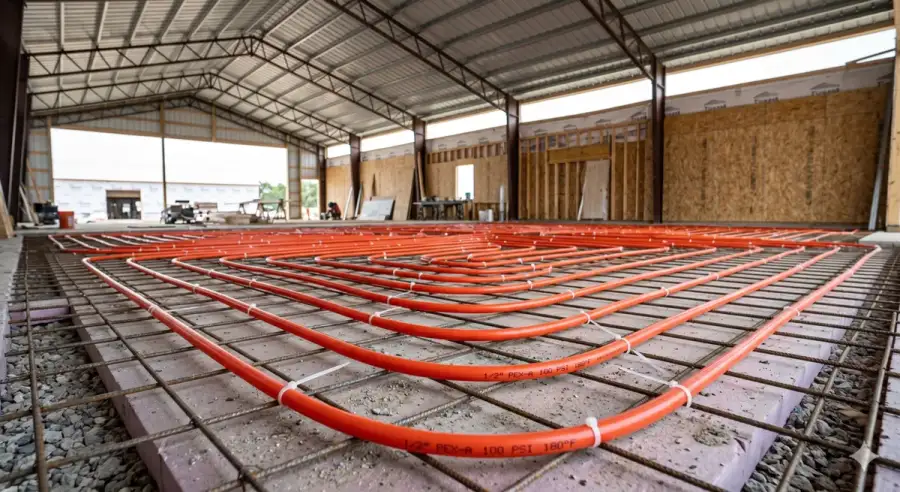
Installation cost for the PEX tubing and manifold system (not including the heat source) runs roughly $6–12 per square foot. For a 2,000 sq ft slab that's $12,000–24,000 for the in-slab portion. This is best done before the pour — adding radiant heat after the fact requires tearing out the slab, which nobody wants.
The right time to spec radiant heat is at the design phase, before your slab is poured. DreamStart can document the planned radiant layout in the pre-construction materials; you independently select, contract, schedule, and manage the concrete contractor who installs it.
Does Geography Matter?
Yes, significantly. Radiant floor heat is an investment whose payback is driven by how many months per year you need it.
Midwest / Great Plains
Climate Zones 4–5
Missouri, Iowa, Kansas, Nebraska, Illinois — 5–6 month heating season. Strong ROI. This is where radiant shines.
Upper South
Climate Zones 3–4
Tennessee, Arkansas, Kentucky — marginal. 3–4 month heating season. Radiant is comfortable but the math is tighter. Mini-splits may be more cost-effective.
Deep South
Climate Zones 1–2
Texas, Oklahoma panhandle, Louisiana — generally not worth it. 6–8 weeks of heat per year. ROI rarely justifies $15,000+ installation.
Flooring Over Radiant: What Works and What Doesn't
This is where most people make expensive mistakes. Every flooring material has a different thermal conductivity rating — how easily heat passes through it to reach the room above. The higher the conductivity, the better the radiant system performs.
Polished or Stained Concrete — Best Possible
Direct contact between the heating system and the room. Zero thermal resistance. Maximum efficiency. Looks incredible when done right — acid-stained or mechanically polished concrete is a premium finish that costs far less than tile or hardwood and works better with radiant than anything else on this list.
Tile or Natural Stone — Excellent
High thermal conductivity, highly durable, compatible with any water temperature. The grout lines don't matter for heat transfer. This is the traditional pairing for radiant heat in high-end builds for a reason.
LVP / LVT Rated for Radiant — Good
Most quality LVP/LVT products are rated for radiant heat up to 85°F surface temperature. Always check the spec sheet before buying. Avoid thick underlayment — it acts as insulation and reduces heat transfer. Use a thin, radiant-compatible pad or none at all.
Engineered Hardwood — Proceed Carefully
Better than solid hardwood but still requires discipline. Keep indoor humidity between 35–50%, ramp system temperature slowly at the start of each season, and don't exceed the manufacturer's stated surface temperature limit (usually 80–82°F). Done right, it works. Done wrong, you'll see cupping and gaps within a couple of winters.
Solid Hardwood — Not Recommended
Wood expands and contracts with moisture and temperature. The repeated seasonal cycling of a radiant system will cause cupping, gapping, and potential structural damage over time. If you're committed to wood, use engineered hardwood with a thick veneer layer, not solid planks.
Wall-to-Wall Carpet — Kills Efficiency
Carpet and thick pad are insulators. A standard carpet-plus-pad combination reduces heat transfer by 30–40%. You're essentially heating the underside of your carpet while running your boiler on overtime. If you must have carpet, zone that room separately and run it hotter to compensate. Wall-to-wall carpet throughout the house over a radiant system is throwing money away.
What About Area Rugs?
Area rugs are fine. A 5×8 rug on polished concrete reduces the heat output in that specific spot, but it's a small fraction of the total floor area. People put rugs on radiant concrete all the time — it's comfortable, normal, and not a meaningful efficiency problem. The issue is wall-to-wall carpet covering 100% of the heated surface, not an area rug in the living room.
Bonus: area rugs on a warm polished concrete floor feel great underfoot. You get the softness in high-traffic areas and the radiant warmth everywhere else.
The Case for Just Leaving the Concrete
In a barndominium or Homestead Shell context, finishing the concrete rather than covering it is often the smartest move — and not just for radiant efficiency. Here's why it keeps coming up in our consultations:
- Polished concrete with radiant heat is a genuinely high-end finish. It reads as modern farmhouse, industrial, or contemporary depending on your trim choices — not as 'unfinished.'
- You avoid the entire flooring compatibility question. No cupping, no cracking, no voided warranty, no spec sheet research.
- Stained or polished concrete costs $3–8/sq ft versus $8–20/sq ft for tile or hardwood — a significant savings on a large floor plan.
- It's indestructible. Dogs, muddy boots, dropped tools, water — polished concrete handles all of it without damage.
- You can always add area rugs, tile inlays, or other finishes later if your taste changes. You can't un-pour a slab.
The customers who leave the concrete and finish it well — acid stain, mechanical polish, or a good epoxy coat — consistently report being happiest with their choice five years in. The ones who put hardwood over the radiant slab occasionally call us wishing they hadn't.
Frequently Asked Questions
Is radiant floor heat a good choice for a barndominium?
Yes — especially in a SIP Homestead Shell. SIP's airtight envelope keeps heat in the space instead of leaking through walls. The system runs at lower water temperatures than it would in a leaky stick-frame house, which means lower operating cost and gentler treatment of flooring above it.
How much does it cost to run radiant floor heat in Missouri?
In a 2,000 sq ft SIP shell in Missouri using a propane boiler, expect $150–280/month during peak winter months. Natural gas runs 30–40% less. Electric resistance is the most expensive at $300–450/month. An electric heat pump water heater used as the boiler is often the most efficient option long-term.
What flooring works best over in-floor radiant heat?
Polished or stained concrete is the best choice — maximum heat transfer, zero compatibility issues. Tile and stone are excellent. LVP/LVT rated for radiant heat (check the spec sheet, most are rated to 85°F surface temp) works well. Solid hardwood is risky due to cupping and gapping. Wall-to-wall carpet with thick pad reduces heat transfer by 30–40% and is generally not recommended.
Will radiant floor heat damage a concrete slab?
No. PEX embedded in concrete is a decades-old, proven installation method. You pour concrete around the tubing and it cures normally. The only precaution: don't run the system at high temperature during initial curing — bring it up slowly (start at 65°F, increase 5°F per day). After that, it's virtually indestructible.
Does location affect whether radiant floor heat is worth it?
Yes. In Missouri and the Midwest (climate zones 4–5), the heating season is long enough that radiant is a strong investment. In the Deep South (zones 1–2), you might only need heat 6–8 weeks a year, and the ROI rarely justifies the installation cost. The farther north you are, the more compelling the math becomes.
About DreamStart
We used to build barndominiums and homestead shells with our own hands — and that experience is exactly what taught us where the real value lies: in getting the design right, planning the build carefully, and working successfully alongside local builders hired by owners. That hands-on experience helps us prepare clearer planning and handoff materials, but it does not make DreamStart the party choosing your contractor. DreamStart now operates as a pre-construction planner and design advisor — not a builder, general contractor, installer, or construction manager. We produce your custom drawings and documentation, coordinate engineering only when your county or lender requires it, and guide site-readiness and logistics. DreamStart designs the plans, organizes the steps, and gets the EPS panels ordered and delivered at the quoted package pricing for your local builder to set. We do not self-perform or include general-contractor labor, excavation, foundations, shell erection, utilities, or finish-out — that work is performed by your local builder and trades you retain, contract, and pay directly. We help you find a general contractor and hold a three-way interview, then hand off a clear written plan. DreamStart does not perform or manage field construction; each owner independently selects, contracts, pays and schedules their contractors. Verify the GC's qualifications, insurance, permit requirements, and lender requirements with the appropriate local authorities and your lender.
Take the Next Step
Ready to Price Your Homestead Shell?
DreamStart designs the plans, organizes the steps, and gets the EPS panels ordered and delivered at the quoted package pricing for the local builder you hire to set. Your GC handles construction. Get your custom estimate free, no obligation.