

Barndominium vs. House:
The Full 2026 Comparison
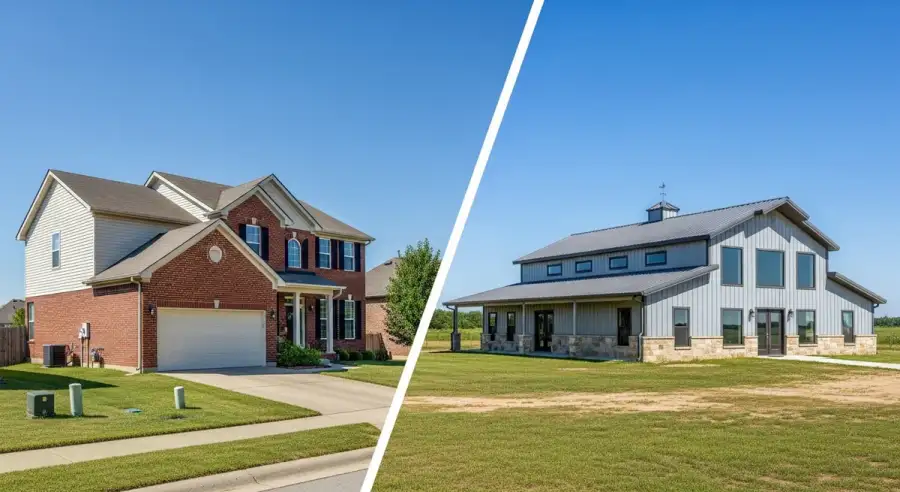
Everyone compares barndominium vs. house on cost. But the real comparison includes lifestyle, maintenance, energy performance, resale, insurance, and the 30-year ownership experience. Here's the complete picture.
“The cost comparison is the headline, but it's not the whole story. I've talked to hundreds of barndominium buyers, and the most satisfied ones aren't the ones who saved the most money. They're the ones who chose the right product for their lifestyle and planned the build with clear eyes.”
John Piazza Norton, Founder, DreamStart Building Company
Barndominiums win on: construction cost (20 to 35% less per sq ft), build speed (5 to 9 months vs 10 to 18 months), energy efficiency with SIP construction (about 12 to 14% energy savings, per the U.S. Department of Energy), and rural lifestyle alignment. Traditional houses win on: appraisal comparables (easier financing), HOA/urban compatibility, and resale liquidity in non-rural markets. The real question is which one fits your specific land, lifestyle, and financial timeline.
Why This Comparison Needs More Than a Price Tag
The barndominium vs. house cost comparison gets enormous attention online, and the cost data is real and meaningful. But buyers who make a $200,000 decision based solely on price per square foot frequently discover that the comparison they needed to do was broader than that.
This is the comparison I have with buyers every week: a full honest accounting of what barndominiums do better, what traditional houses do better, and where the lines blur. My goal is to help you choose correctly for your situation, which means being honest about both the advantages and the genuine limitations of each.
Construction Cost: Barndominium Wins
A SIP Homestead Shell on a slab foundation in Missouri runs $90 to $140/sq ft total (complete, move-in ready). A comparable quality stick-built house on the same footprint runs $140 to $200/sq ft. The gap is real: typically 20 to 35% less expensive per square foot for a barndominium build at equivalent finish levels.
The sources of the savings:
Honest caveat: These savings assume you're comparing a barndominium on rural acreage to a house on rural acreage. Comparing a barndominium to a suburban tract home involves so many different variables (lot cost, development infrastructure, zoning requirements) that the comparison loses meaning.
Build Speed: Barndominium Wins
A SIP Homestead Shell is weather-tight in 3 to 5 days on site once your site, panels and builder are in place. From groundbreaking to dried-in shell: typically 60 to 90 days (slab cure time dominates this phase). From dried-in to move-in: 3 to 6 months for a motivated owner-builder, or 4 to 8 months hiring out interior trades.
| Phase | SIP Barndominium | Stick-Built House |
|---|---|---|
| Groundbreaking to dried-in | 60 to 90 days | 4 to 6 months |
| Dried-in to move-in | 3 to 6 months | 6 to 12 months |
| Total timeline | 5 to 9 months | 10 to 18 months |
Energy Performance: Barndominium Wins (with SIP)
A SIP Homestead Shell beats a new code-built house on energy. The U.S. Department of Energy puts typical SIP energy savings at about 12 to 14%, and in an Oak Ridge National Laboratory test a SIP room leaked about 15 times less air than a 2x6 stick-framed room. The R-26+ walls, R-40+ roof, and nearly airtight envelope mean smaller HVAC equipment and lower monthly bills.
Important qualifier: This advantage applies to SIP barndominium construction. A post-frame barndominium with batt insulation can perform worse than a code-built house. The energy advantage is a function of the SIP building system, not of the barndominium form factor.
See how a SIP Homestead Shell pencils out on your project
Get a free shell estimate: line-item pricing for your square footage and layout.
Financing: Traditional House Wins
Conventional mortgage programs (Fannie Mae, Freddie Mac, FHA, VA for primary residence refinancing) are designed for traditional houses. They require comparable sales for appraisal, which are abundant in almost every market for a 3-bedroom, 2-bath stick-built house on a standard lot.
Barndominium financing requires portfolio lenders. These lenders (rural lenders, community banks, agricultural credit unions) exist and are workable, but the process requires more research, more documentation, and typically more money down (20 to 30% vs 10 to 20% for conventional construction loans).
Maintenance: Barndominium Wins
Metal exterior cladding requires essentially no maintenance: no painting, no wood rot, no re-siding. Standing seam metal roofing carries a 40 to 50 year lifespan with minimal maintenance beyond periodic inspection. Concrete slab floors require no structural maintenance.
Traditional houses with wood siding require painting every 5 to 10 years. Asphalt shingle roofs require replacement every 20 to 25 years. Basements and crawl spaces require periodic inspection, moisture management, and occasional remediation.
Resale & Appraisal: Traditional House Wins (in most markets)
The resale liquidity of a traditional house is higher than a barndominium in most markets, simply because the pool of qualified buyers is larger. Any buyer who can get a conventional mortgage can buy a traditional house. Barndominium buyers need to find portfolio lenders, which reduces the buyer pool and can slow sales.
The appraisal comparable sales problem is real in thin markets. In counties where few barndominiums have sold, appraisers have limited data to work with. This can result in conservative appraisals that don't reflect the actual replacement cost of the building.
The counter-argument: This gap is closing. As barndominium construction has grown in Missouri over the past decade, comparable sales data has accumulated. In Northwest Missouri, where many DreamStart planning clients are based, the comp pool has grown enough to give appraisers more local data for a well-built SIP Homestead Shell. In thin markets (rural counties with minimal barndominium history), the appraisal risk is real.
Lifestyle Fit: Depends Entirely on Your Land and Plans
Barndominium excels for:
Traditional house excels for:
Full Side-by-Side Comparison
| Factor | Traditional House | SIP Barndominium |
|---|---|---|
| Construction cost | $140 to $200/sq ft | $90 to $140/sq ft |
| Build timeline | 10 to 18 months | 5 to 9 months |
| Energy use | Code baseline | About 12 to 14% lower (DOE, SIP) |
| Monthly utility (2,000 sq ft) | $150 to $250/mo | $60 to $120/mo |
| Financing ease | Conventional/FHA/VA available | Portfolio lenders (20 to 30% down) |
| Exterior maintenance (30 yr) | High ($20K to $50K+) | Minimal (metal cladding) |
| Resale liquidity | High (broad buyer pool) | Moderate (rural markets strongest) |
| Lifestyle / open plan | Limited by load-bearing walls | Virtually unlimited interior volume |
“Most of the people who ask me this question already know which one they want. The barndominium vs. house question is usually a gut-check before a decision they've already arrived at emotionally. My job is to make sure the financial and practical reality supports what they want to build, and in most cases for rural Missouri buyers planning long-term ownership, it does.”
John Piazza Norton, Founder, DreamStart Building Company
The Honest Recommendation
If you own rural land, plan to live there for 10+ years, and value the open plan lifestyle and lower utility costs over the incremental financing ease of a traditional house, a SIP Homestead Shell is almost certainly the better choice for your situation.
If you're building in a suburb, plan to sell in five years, or need conventional financing because you can't manage a 20 to 30% down payment, a traditional house is the more practical choice.
Related Reading
About DreamStart
We used to build barndominiums and homestead shells with our own hands, and that experience is exactly what taught us where the real value lies: in getting the design right, planning the build carefully, and working successfully alongside local builders hired by owners. That hands-on experience helps us prepare clearer planning and handoff materials, but it does not make DreamStart the party choosing your contractor. DreamStart now operates as a pre-construction planner and design advisor, not a builder, general contractor, installer, or construction manager. We produce your custom drawings and documentation, coordinate engineering only when your county or lender requires it, and guide site-readiness and logistics. DreamStart designs the plans, organizes the steps, and quotes the EPS panel price; your local builder buys the panels directly from EPS at that price and sets them. We do not self-perform or include general-contractor labor, excavation, foundations, shell erection, utilities, or finish-out. That work is performed by your local builder and trades you retain, contract, and pay directly. We help you find a general contractor and hold a three-way interview, then hand off a clear written plan. DreamStart does not perform or manage field construction; each owner independently selects, contracts, pays and schedules their contractors. Verify the GC's qualifications, insurance, permit requirements, and lender requirements with the appropriate local authorities and your lender.
Take the Next Step
Ready to Price Your Homestead Shell?
DreamStart designs the plans, organizes the steps, and quotes the EPS panel price; the local builder you hire buys the panels directly from EPS at that price and sets them. Your GC handles construction. Get your custom estimate free, no obligation.