

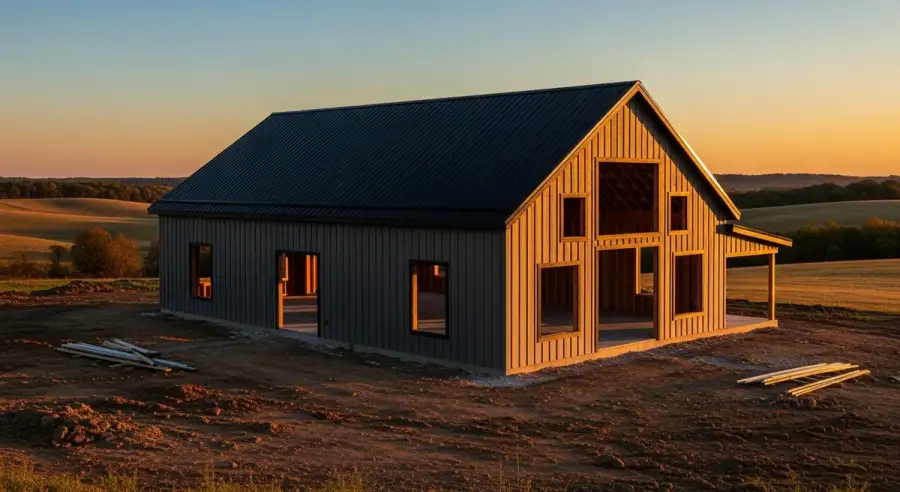
Why Kansas City Metro Buyers Build in the Surrounding Counties
Barndominiums require rural land: residential or agricultural zoning without subdivision deed restrictions, adequate acreage for a private well and septic system, and county rules that allow a home on rural acreage. None of that exists within Kansas City's city limits or its immediately adjacent suburbs.
What does exist, 20 to 50 miles from the KC metro, is some of Missouri's most attractive rural land for barndominium builds: rolling terrain in Platte County, productive agricultural ground in Clinton and DeKalb counties, the Missouri River corridor in Ray and Carroll counties, and Buchanan County (home of St. Joseph) with its strong rural building culture.
KC metro buyers who own or are purchasing rural land in these counties face a specific challenge: most Kansas City contractors don't have the rural construction experience, the rural supplier relationships, or the familiarity with rural county permit offices that a rural barndominium build requires. Finding the right builder means looking beyond the metro's contractor base.
Understanding Each County's Building Environment
The counties within a reasonable drive of Kansas City each have distinct rules. Here is what each county has confirmed in its own documents or in writing (or what the state's 2021 building code data shows). For anything not listed, ask the county:
- Platte County: The closest major rural county to KC's northwest metro. Zoned, with the 2018 IRC/IBC and related codes adopted. A building permit is required, with sealed engineer drawings and a surveyor site plan. The AG district allows one dwelling per 40 acres. Platte County Planning and Zoning: 816-858-3338.
- Clay County: More mixed urban-rural character near KC's north boundary. Clay County has adopted the 2012 IRC/IBC and the 2011 NEC, and requires permits and inspections for almost all construction; the Clay County Public Health Center inspects septic. Cities in the county have their own rules, so know whether your land is in a city or unincorporated. Clay County Planning and Zoning: 816-407-3380.
- Clinton County (Cameron area): Zoned, and a permit is required to build a house or modular home, though the Zoning Order adopts no building code. The order sets a 950 sq. ft. minimum home size in the agricultural districts, one primary residence per parcel, and minimum lots of 20 acres (Ag A), 10 to 19.99 acres (Ag B) and 5 acres (R-1). Contact Clinton County Planning and Zoning through clintoncomo.org.
- DeKalb County: One of the more rural counties in the KC orbit, with no adopted code in the state's 2021 data. The county has no zoning authority of its own; Colfax, Washington and Grand River townships zone. Septic goes through Missouri DHSS. Ask the County Clerk in Maysville (816-449-5402) about any county permit.
- Buchanan County: St. Joseph is the county seat and the center of northwest Missouri's building trades. The county is zoned and requires a permit for any structure, though its Zoning Order adopts no building code. Minimum lots are 20 acres in A-1 and 2 acres in A-OR, and the county Environmental Inspector approves septic. Buchanan County Planning and Zoning: 816-271-1528.
- Ray County: Northeast of KC along the Missouri River, with Richmond as the county seat. No adopted code in the state's 2021 data, but a building permit is required ($0.40 per sq. ft. of livable space), with footing, rough-in and final inspections. Minimum lot is 3 acres, and the minimum home is 1,000 sq. ft. single story on lots under 19 acres. Ray County Planning and Zoning: 816-776-5398.
What to Look For in a Barndominium Builder
The builder you hire for a rural barndominium in the KC orbit needs specific capabilities that many residential contractors don't have:
- Rural permit experience: Have they pulled permits in your target county? A builder who works primarily in Overland Park or Blue Springs may not know how a rural county like DeKalb or Ray handles permits, townships and septic.
- SIP panel experience (if applicable): If you're specifying a Solid-Core SIP shell, verify that the builder has installed SIP panels before. Ask for the name of a SIP project they completed and whether you can visit it or speak with that client.
- Engineered drawings: A legitimate barndominium builder uses engineered plans: structural drawings stamped by a licensed Missouri PE. Builders who offer to work from hand sketches or generic plans without engineering are not set up for permitted construction or for a construction lender's review.
- Subcontractor network: Rural builds require rural subcontractors: well drillers, septic installers, rural electric co-op coordination, concrete crews comfortable with rural site access. A builder without established rural subcontractor relationships will struggle to coordinate your project efficiently.
- References from comparable builds: Ask for two or three references from barndominium projects (not conventional residential projects) completed in rural settings. Call those references. Ask specifically about communication during the project and whether the final cost matched the original quote.
Red Flags to Watch For
Some warning signs that an inexperienced or unqualified builder is presenting themselves as a barndominium specialist:
- Square-foot pricing without a site visit: Legitimate builders won't quote a rural barndominium without visiting the site. Site conditions (access road quality, distance from utilities, soil bearing capacity, slope) materially affect cost. Any builder who gives you a firm price per square foot without seeing the land is estimating blind.
- No engineering or generic plans: "I have a standard barndominium plan I use" is not an adequate answer for a structure that needs to meet local wind and snow load requirements and pass building department plan review.
- Kit shell proposals without engineering coordination: Many companies sell online barndominium kit packages: pre-priced steel building kits that ship to your site. These kits can be legitimate building components, but they require engineering to meet Missouri code requirements and a builder experienced in their assembly. A builder who simply re-sells kit packages without engineering coordination is not equipped to be your general contractor.
- No license or insurance: Missouri has no statewide general contractor license, but some cities and counties license contractors and trades locally (Jackson County, for example, requires licensed electrical, mechanical and plumbing work). Ask for any local license your county or city requires and request a certificate of insurance showing general liability and workers' compensation coverage before signing any contract.
Working with DreamStart in the Kansas City Area
DreamStart Building Company is headquartered in northwest Missouri and works with owners in the rural counties north and east of Kansas City (Buchanan, Platte, Clinton, DeKalb, Nodaway, and surrounding areas). We design for land in Missouri and nearby states; panels ship from Iowa. As an EPS Authorized Dealer, DreamStart has access to the full EPS Solid-Core SIP product line for projects across this region. EPS panels ship from Iowa, so the product line is close at hand for this region.
If you're a KC metro buyer with rural land in our service area, the process begins with a no-obligation Planning Call and a shell estimate from our calculator. DreamStart provides custom drawings and documentation for your county's review and quotes the EPS panel package. Your builder buys the panels directly from EPS at the price DreamStart quotes and sets them. You select, contract, pay, schedule, and manage that builder for field assembly.
The best next step is to run your numbers in our free calculator, then schedule a 30-minute call to discuss your specific county, site, and timeline. Most KC metro buyers are surprised to find that a professional Homestead Shell build is within reach, and that the process is more straightforward than they expected once they know their county's rules.