

How to Find Land for a Barndominium
in Missouri (2026 Site Selection Guide)
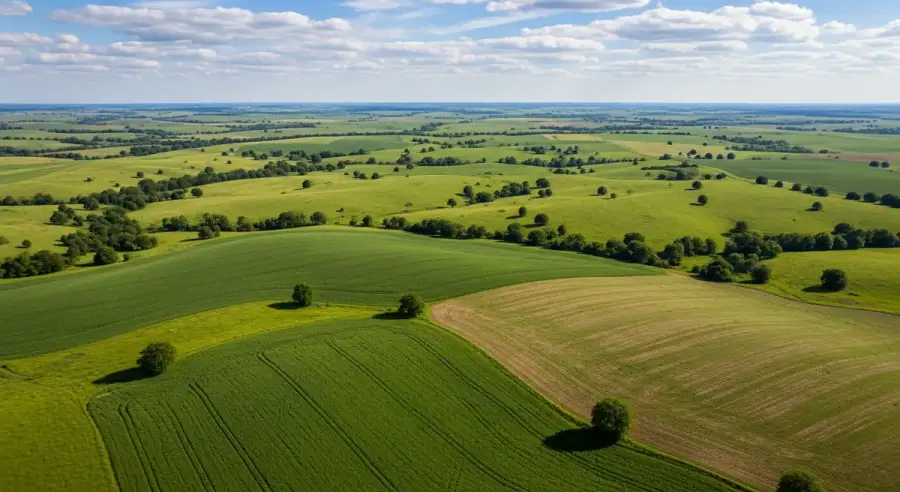
The satellite image looks perfect. But a limestone shelf, floodplain, or buried deed restriction can kill your build before you pour a single yard of concrete.
“Every build problem I've seen that wasn't about money was about land. Wrong zoning, a failed perc test on closing day, a deed restriction buried in a 1979 warranty deed, a build pad that turned out to be in a floodway. The land is the foundation of the foundation. Spend 80% of your early energy getting it right before you touch a blueprint.”
John Piazza Norton, Founder, DreamStart Building Company
The difference between a smooth Missouri barndominium build and a nightmare is almost always the land. Missouri has plenty of rural land for sale, but the site that looks perfect on satellite can have a limestone shelf two feet down, a 100-year floodplain crossing the build pad, or deed restrictions from a previous owner who hated metal roofs. Do your soil evaluation before you make an offer. Verify zoning allows residential construction. And know that finding land is step one: you'll need a land loan before you qualify for a construction loan, and those two processes run on different timelines.
1. Where to Find Rural Land in Missouri
Not all land listings end up on Zillow. Missouri rural parcels, especially the 5-to-40-acre range that's ideal for a Homestead Shell build, are often sold through specialized channels that most buyers never look at. Start wide, then narrow.
Lands of America / LandWatch
Large national rural land listing sites. Filter by county, acreage, and price. Many listings include aerial maps, and some add soil or zoning notes.
Missouri Regional MLS
Parcels listed by local Missouri Realtors often don't syndicate to national platforms. A local agent with rural land experience (look for a Realtors Land Institute, or RLI, designation) will have access to listings you'd otherwise miss, plus knowledge of which townships have restrictive deed covenants.
Agricultural Lender Listings
Agricultural lenders often maintain their own land listing platforms tied to distressed or estate-sale properties. These sometimes sell below market because buyers have limited financing options, but barndo buyers who already have a land loan relationship with these lenders have an inside track.
County Tax Sales & Auctions
Missouri counties auction tax-delinquent land annually. You can find raw acreage at steep discounts, but title is messy (quitclaim only) and due diligence is compressed. Best suited for experienced buyers who can carry the title risk while clearing clouds through quiet title action.
Direct Outreach to Farm Operators
Many Missouri farm owners will sell off a rear 10 or 20 acres that are too small to farm efficiently. Find farm operations near your target area through USDA Farm Service Agency maps and approach directly. You won't face competition, and sellers often provide seller financing.
Need land to build on? We can help. Call (816) 388-0462.
2. What to Look For in a Missouri Build Site
Before you fall in love with a parcel, run through this site evaluation mentally from the satellite view, then in person before making an offer. These are the factors that separate a buildable site from a problem site, and Missouri has specific landmines you won't find in other states.
Road Frontage & Legal Access
Verify the parcel has legal road frontage (a deeded easement doesn't always count for permit purposes). Many counties and lenders require legal road access before they will permit or finance a home; ask the county. Landlocked parcels are a title nightmare. Avoid them unless you're getting an explicit access easement at closing.
Electricity at the Road
Find out which utility serves the parcel. Depending on where you are, that may be Evergy or your local electric cooperative. Off-grid solar is an option. Bringing power in from the road is common, and a long run can cost thousands. Ask the utility for a line-extension estimate before you buy.
Well Suitability
Missouri DNR well logs (searchable through the DNR's online well search at dnr.mo.gov) show historic well depth and yield data for your area. In the Ozarks, karst limestone aquifers are common: reliable, but they require proper casing. In northwest Missouri, water tables tend to be shallower. Review neighboring well logs before drilling.
Topography & Build Pad
You want a naturally flat or gently sloping area for your slab. Identify the build area on a USGS topo map and estimate cut/fill. A site that requires more than 3 feet of cut or fill on the build pad adds $10,000 to $40,000 to your budget before a single SIP panel ships.
Flood Zone (FEMA Map)
Pull the FEMA Flood Map at msc.fema.gov for the parcel's coordinates. Zone X = low risk. Zone AE or AO = high risk, mandatory flood insurance, and possible floodway restrictions that prohibit permanent structures entirely. A stunning creek-bottom lot may be in a floodway, which makes it unbuildable.
Ozarks Limestone & the Rock Tax
South of the Missouri River, limestone shelves are often 18 to 36 inches below surface. On your site visit, probe with a rebar stake or hire a geotechnical probe ($200 to $400) before closing. Hitting solid rock means blasting for footings, easily $30,000+ extra in southern Missouri counties.
Wetlands & Waterway Setbacks
The Army Corps of Engineers and Missouri DNR regulate work in wetlands and streams, and some counties add stream setbacks. Satellite imagery often masks seasonal wetlands. A quick check on the U.S. Fish & Wildlife Service Wetlands Mapper (fws.gov) can save you from a federally protected headache.
Cell Coverage
Rural Missouri cell coverage is uneven. If you're planning to work from home or use cellular backup for internet, check each major carrier's coverage map for the specific parcel coordinates, not just the nearest town. Better yet, test your phone on the parcel.
3. Zoning, Deed Restrictions & the Missouri County Wild Card
Missouri has 114 counties plus St. Louis City. Some have full planning and zoning departments. Others have no zoning whatsoever. And a few allow agricultural uses but prohibit metal building exteriors via deed covenants, even on land that looks wide open on a map.
Missouri Zoning Reality
Many rural Missouri counties have no countywide zoning. Nodaway, Harrison, Grundy and Worth confirmed that to us in writing. Missouri has no statewide residential building code, and in the state's 2021 data 102 of 115 county entries list no adopted county code. Some unzoned counties still require a county building permit and some don't, and septic rules apply either way. In counties with zoning, agricultural (AG) classification almost always allows residential dwellings, but call the county P&Z office to confirm before you make an offer.
County P&Z: The One Phone Call That Saves Everything
Call the county Planning & Zoning office (or county clerk in unzoned counties) with the parcel's legal description and ask three questions:
Is a single-family residential dwelling permitted on this parcel?
Are there any restrictions on exterior materials, specifically metal siding or metal roofing?
What permits are required, and what building code is enforced (IBC, IRC, or county-specific)?
Deed Restrictions: The Hidden Killer
Even on land with no zoning, the previous owner may have recorded deed restrictions that run with the land forever. These commonly include prohibitions on:
Metal building exteriors
Mobile or manufactured homes
Agricultural livestock
Commercial activities
Minimum square footage requirements
Exterior color restrictions
How to check: Request a title search before closing and ask the title company to flag all recorded covenants, conditions, and restrictions (CC&Rs). This is standard, but you must ask; some title companies don't flag restrictions proactively.
4. Soil Tests & Septic Suitability: Before You Close
Outside city limits, your septic system is your wastewater facility. Missouri law requires a percolation (perc) test or soil evaluation before any septic permit is issued. And here's the truth most buyers learn too late:
The Costliest Land Mistake in Missouri
Purchasing land without a septic suitability evaluation, then discovering the soil fails. On sites with shallow clay or fractured limestone, which are common in the Missouri Ozarks, a conventional septic system may not be approved. You're then forced into a mound system ($15,000 to $25,000 more) or an aerobic treatment unit ($20,000+), or the land simply can't be permitted for residential use at all.
Before Making an Offer
Pull the USDA Web Soil Survey (websoilsurvey.sc.egov.usda.gov) for the parcel; check the septic absorption field suitability rating
Ask the county health department if similar parcels nearby have been permitted
Include a septic feasibility contingency in your purchase contract
During Your Contingency Period
Hire a licensed Missouri professional soil evaluator ($400 to $800) for a formal perc/soil test
Get a preliminary septic design from a licensed engineer before closing
Verify the 3-acre exemption status for your specific county (some, like Jefferson and Boone, permit every system regardless of lot size)
Missouri 3-Acre Rule: State law exempts properties of 3+ acres from mandatory sewage treatment, but this only applies to specific system types and is not a license to skip permitting. Lenders will require a permitted septic system regardless of acreage. See our complete Missouri septic guide for county-by-county details.
5. How Many Acres Do You Actually Need?
Missouri buyers often over-buy or under-buy on acreage. Here's a practical guide to what different lot sizes enable and what they cost to develop:
| Acreage | What's Possible | Watch Out For |
|---|---|---|
| 1 to 2 acres | Single home, garage, small outbuilding. Tight on setbacks in some counties. | May fall under a county's minimum lot size or not suit a conventional septic system. No room for expansion. |
| 3 to 5 acres | Home + shop + detached garage. Standard septic setbacks typically satisfied. | Shop setbacks from property lines: confirm county requirements. |
| 5 to 10 acres | Full homestead: home, shop, small barn, garden, a few animals. Privacy buffer. | More acreage = more perimeter fence, longer driveway, more mowing. |
| 10 to 40 acres | Agricultural lifestyle possible. Enough for small livestock operation, timber, pond. | Higher land cost and longer utility runs. AG loan terms may differ. |
| 40+ acres | Full working farm alongside homestead. Timber income potential. | Typically requires agricultural lender. Higher property management burden. |
6. The Land Loan → Construction Loan Sequence
Most buyers don't realize that buying land and building a barndominium require two separate financing events, each with its own underwriting, appraisal, and closing costs. Knowing the sequence prevents costly surprises:
Land Loan
Who Lends
Agricultural lenders, local community banks, sellers
Typical Terms
20 to 30% down, 5 to 10 year term, floating rate. Raw land rates are higher than improved land.
Construction Loan
Who Lends
Community banks, credit unions, USDA OTC loan (one-time close), VA OTC
Typical Terms
12 to 18 month draw-based loan. Funds release in stages as builder completes milestones. Interest-only during construction.
Permanent Mortgage
Who Lends
Most conventional lenders (if SIP, appraised residential; not as 'post-frame')
Typical Terms
Rolls from construction loan at completion. 30-year fixed or ARM. This is where classification matters.
Is your land USDA-eligible?
Type the address of your land (or the nearest road address). We'll check it against USDA's eligibility map for zero-down home loans and show what we know about your county's building rules.
Based on USDA Rural Development's public eligibility map for single-family housing. This isn't a final determination; USDA decides eligibility when you apply, and income limits also apply. Confirm on USDA's map . We don't save the address you enter unless you ask Mike to call.
7. The 10-Point Missouri Land Due Diligence Checklist
Run through every item on this list before you remove contingencies. Print it out and bring it to your site visit.
Legal road frontage or recorded access easement
FEMA flood zone check at msc.fema.gov
County P&Z call: residential permitted + no metal restrictions
Title search with CC&R deed restriction review
Soil evaluation / septic feasibility (contingency period)
Utility presence or extension cost estimate
USGS topo map: build pad topography
Missouri DNR well log search (dnr.mo.gov)
Wetlands check (USFWS Wetlands Mapper)
Geotechnical probe for Ozarks limestone (south MO only)
Related Reading
The Missouri Barndominium Septic Survival Guide
Soil test order of operations, 3-system comparison, and a county-by-county health department finder for all 114 Missouri counties.
Financing GuideHow to Finance a Barndominium in Missouri (2026)
Construction loans, USDA rural financing, and how paid-off land can serve as your construction loan down payment.
Buyer's GuideBarndominium Property Taxes in Missouri
How to keep your build classified residential (19%) instead of commercial (32%), starting from permit day.
About DreamStart
We used to build barndominiums and homestead shells with our own hands, and that experience is exactly what taught us where the real value lies: in getting the design right, planning the build carefully, and working successfully alongside local builders hired by owners. That hands-on experience helps us prepare clearer planning and handoff materials, but it does not make DreamStart the party choosing your contractor. DreamStart now operates as a pre-construction planner and design advisor, not a builder, general contractor, installer, or construction manager. We produce your custom drawings and documentation, coordinate engineering only when your county or lender requires it, and guide site-readiness and logistics. DreamStart designs the plans, organizes the steps, and quotes the EPS panel price; your local builder buys the panels directly from EPS at that price and sets them. We do not self-perform or include general-contractor labor, excavation, foundations, shell erection, utilities, or finish-out. That work is performed by your local builder and trades you retain, contract, and pay directly. We help you find a general contractor and hold a three-way interview, then hand off a clear written plan. DreamStart does not perform or manage field construction; each owner independently selects, contracts, pays and schedules their contractors. Verify the GC's qualifications, insurance, permit requirements, and lender requirements with the appropriate local authorities and your lender.
Take the Next Step
Ready to Price Your Homestead Shell?
DreamStart designs the plans, organizes the steps, and quotes the EPS panel price; the local builder you hire buys the panels directly from EPS at that price and sets them. Your GC handles construction. Get your custom estimate free, no obligation.