

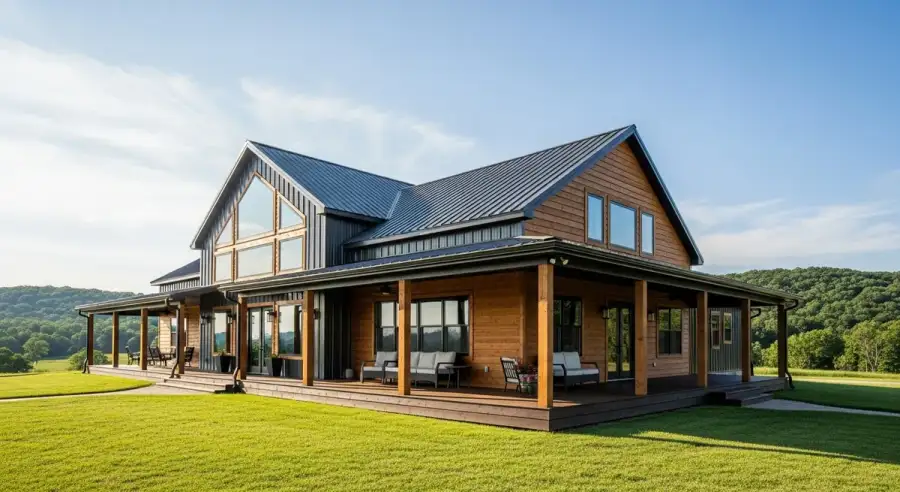
The Short Answer: Yes, and Missouri Is One of the Most Permissive States
There is no Missouri law, regulation, or statewide code that prohibits barndominiums. You can build a Homestead Shell on rural land in Missouri, obtain the required permits, get it appraised as residential property, and finance it with a construction loan, all within the existing legal framework. Full stop.
The complications are not from state law. They come from local zoning ordinances (which vary by county), deed restrictions on specific parcels, and the secondary mortgage market's comfort level with non-traditional construction, which is a financing question, not a legal one.
Missouri's Building Code Framework
Most states have a statewide mandatory building code that all jurisdictions must enforce. Missouri takes a different approach: there is no statewide residential building code. Counties and cities may adopt the International Residential Code (IRC), and adoption and enforcement are local decisions. This means:
- Metro counties have adopted residential codes: Clay, Platte and Jackson around Kansas City and Boone around Columbia confirm a code and a required building permit in their own documents, and the state's 2021 data also lists a code for St. Louis County and Greene (Springfield). Only 13 of 115 county entries list an adopted residential code in that data.
- Many counties with no adopted code still have zoning and require a permit. Buchanan County (St. Joseph) has no adopted residential code but zones rural land with minimum acreage for a home; Ray and Caldwell counties require a building permit; Clinton and Carroll counties are zoned and require a permit.
- Some rural counties have no adopted code, no county zoning and no county building permit outside city limits. Nodaway, Harrison and Worth told us so in writing. Septic rules still apply: most new systems need a permit from the county or the state (DHSS), and wells follow MoDNR rules.
The Zoning Classification Question
Even in counties with no building code, you need to confirm the land is zoned for residential use. The most barndominium-friendly classification is Agricultural (A-1, A-2, AG), which allows residential structures as a matter of right: a primary residence on agricultural land is generally allowed, subject to the county's minimum lot size (for example 20 acres in Clinton County's Agriculture District A and Buchanan County's A-1 district).
Rural Residential (RR) zones also typically allow barndominiums, sometimes with specific setback requirements or minimum square footage rules. Standard residential subdivision lots (R-1, R-2) commonly have deed restrictions prohibiting metal siding, requiring minimum square footage, or mandating specific exterior materials. These restrictions are in the deed, not county code, and they survive changes in county law. Always pull the deed restrictions on a platted lot before buying.
How Zoning Classification Affects Your Property Taxes
Missouri assesses residential real property at 19% of market value and agricultural property at 12%. However, a barndominium used as a primary residence needs to be classified as residential (19%), not as a commercial building (assessed at 32%). To get the residential classification, you typically need to demonstrate that the structure is your primary residence. Utility bills, voter registration, and an application to the county assessor are the standard approach.
The good news: DreamStart Homestead Shells are designed to residential specifications and documented as residential structures. The county assessor has clear evidence that the building is a home, not a barn.
What Protects You at Appraisal and Resale
Even in counties where no building permit was required, documentation of residential construction quality matters enormously at two future moments: when you try to refinance (the appraiser needs to establish value) and when you sell (the buyer's lender needs the same confidence).
DreamStart provides a full custom drawings package and a construction specification with every design agreement. That documentation establishes that the structure was built to residential engineering standards, regardless of whether the county required a permit to verify it. For buyers in no-code counties, this documentation gives lenders and appraisers what they need to complete a transaction confidently.
What Happens If You Build Without Confirming Legality First
The consequences of skipping the zoning and deed restriction research aren't immediate. They surface years later when you need them least. The most common scenarios we hear about: a buyer builds a barndominium on a platted rural lot with recorded deed restrictions prohibiting metal siding, then tries to refinance three years later only to discover the structure violates the covenants. The lender won't refinance a property in violation of its own deed restrictions. The seller of the land didn't disclose the restrictions (sometimes because they didn't know), and the title insurance doesn't cover the situation because the restrictions were technically disclosed in the chain of title. They just weren't read.
A second common scenario: a buyer builds in what they believe is an unincorporated area without a building code, then discovers at resale that the county had adopted the IRC two years before they broke ground, and without a certificate of occupancy, the buyer's lender won't close. Both situations are completely avoidable with a single phone call to the county P&Z office and a deed restriction search before closing on land. This is not exotic legal research. It's the basic due diligence that any experienced rural builder completes on every project before the first stake goes in the ground.
The Bottom Line on Legality
Missouri is an excellent state to build a barndominium. The legal framework is permissive, the rural land is available, and the building culture in northwest Missouri specifically has deep familiarity with agricultural-style residential construction. The question to ask before you commit to a parcel isn't "is a barndominium legal here?" It's "what are this county's specific requirements, and does this parcel's zoning support what I want to build?" That research takes a phone call and a title search, both of which we recommend doing before any land purchase decision.