

The Two Metal Roof Systems: What Builders Actually Use
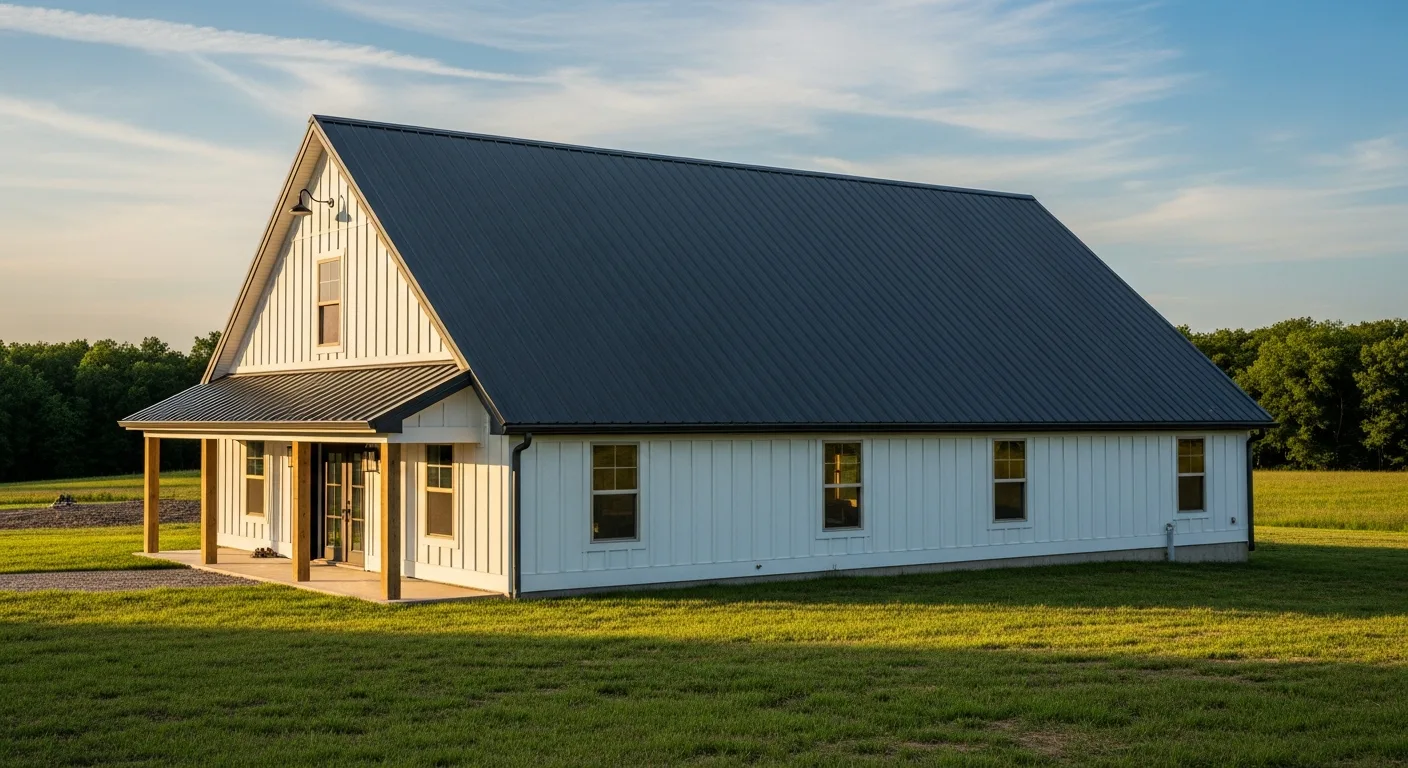
Missouri barndominium roofs are almost universally metal. Wood shingles don't suit the aesthetic, and composite shingles don't suit the longevity expectations of buyers who are investing in a structure designed to last 50+ years. But "metal roof" covers a spectrum, from cheap agricultural R-panel to architectural standing seam systems with 40-year paint warranties, and the difference in performance, longevity, and maintenance cost is significant.
The two primary metal roofing systems used on barndominiums are exposed-fastener panels (commonly called R-panel or PBR panel) and concealed-fastener standing seam. Understanding the practical differences between them, beyond just the price tag, helps you make an informed decision for your build.
Exposed-Fastener (Screw-Down) R-Panel
R-panel is the classic agricultural metal roofing profile. It's installed with screws that penetrate through the panel surface into the roof purlins below. The screws are visible from the exterior and are fitted with rubber or neoprene washers to create a weatherproof seal at each penetration.
Advantages: Lower material and installation cost (typically 20 to 30% less than standing seam), widely available from regional suppliers, faster to install, easier for owner-builders to source locally.
Disadvantages: The screw penetrations are the system's primary failure point. As the metal panel expands and contracts through Missouri's temperature extremes (100°F summer highs to -10°F winter lows), the washers at each screw gradually compress and harden. Most exposed-fastener roofs need screw inspection and washer replacement at 10 to 15 years. Failure to maintain the screws allows water infiltration at each penetration point, potentially hundreds of entry points across the roof surface.
R-panel works well for shop and outbuilding applications where appearance is secondary and access for maintenance is straightforward. For the living area of a barndominium, where a roof leak means damaged ceilings, drywall, and contents, we recommend standing seam.
Standing Seam: The Superior System for Residential Applications
Standing seam metal roofing uses concealed fasteners: the structural attachment clips are hidden beneath the raised seams that run vertically down the roof slope. No fastener penetrates the panel surface. The panels connect to each other at the raised seam, which is mechanically locked or snapped together, creating a watertight joint without exposed screws.
Advantages: No exposed fasteners means no washer failures and no through-panel penetrations. Panels can float (expand and contract) freely along their length without stressing attachment points. 40-year paint warranties are standard from manufacturers like ATAS, McElroy Metal, and Metal Sales on properly specified Kynar 500 coatings. Much quieter than R-panel in rain and hail because the continuous panel surface doesn't telegraph sound the same way, especially when installed over solid decking.
Disadvantages: Higher material and labor cost. Requires more skilled installation; standing seam installation errors are less forgiving than R-panel errors. Not all roofing contractors in rural Missouri are experienced with standing seam; verify credentials before hiring.
Gauge: Why 26 Over 29
Steel gauge runs counterintuitively: a lower gauge number is a thicker, heavier panel. The difference between 26 and 29 gauge is meaningful for Missouri conditions:
- 29 gauge (0.014 inches): Standard agricultural-grade thickness. Adequate for outbuildings and shop areas. More susceptible to hail denting. Missouri's hail season (spring and early summer) produces hailstones that regularly dent 29-gauge panels. Most 29-gauge panels carry a 40-year rust-through warranty but shorter paint warranties.
- 26 gauge (0.019 inches): Residential and commercial standard for standing seam applications. Meaningfully more resistant to hail denting. Carries better paint warranties. Required by most manufacturers for their full Kynar 500 40-year paint warranty.
- 24 gauge (0.024 inches): Premium grade used on high-end residential and commercial projects. Highest dent resistance, longest warranty eligibility. Cost premium of 15 to 20% over 26-gauge.
For the living area of a barndominium, specify 26-gauge minimum. For shop and garage areas, 29-gauge is acceptable if cost is a significant factor.
Coatings: Galvalume vs. Kynar 500
The coating on your metal roof determines its corrosion resistance and color retention over decades:
- Galvalume: An aluminum-zinc alloy coating applied to the steel substrate. Provides excellent corrosion resistance; Galvalume panels typically carry 40-year rust-through warranties. Good for unpainted or bare metal aesthetic looks (the classic silver barn appearance).
- Kynar 500 (PVDF resin): A high-performance fluoropolymer paint coating applied over the Galvalume substrate. Kynar 500 is the gold standard for color retention. It maintains color fidelity for 40+ years with minimal fading or chalking. Required for the maximum paint warranty from manufacturers. Most quality standing seam panels are Kynar 500 coated.
- SMP (Silicone Modified Polyester): A step below Kynar in performance, commonly used on lower-cost panels. Carries 30 to 35 year paint warranties and shows more color fading over time. Often used on R-panel products.
Color Selection and Solar Reflectance
Color affects more than aesthetics. It affects your barndominium's cooling load in Missouri summers. The Solar Reflectance Index (SRI) measures how much solar energy a surface reflects. Higher SRI = cooler roof surface = less heat transferred into the structure.
Light colors (galvalume, light gray, tan, light blue) have SRI values of 50 to 75. Dark colors (charcoal, dark brown, black) have SRI values of 5 to 20. In Missouri's climate, a charcoal roof absorbs significantly more solar energy than a light gray roof, which translates to higher HVAC loads in summer. SIP construction's excellent insulation mitigates this somewhat, but the effect is real and measurable.
Popular color choices for northwest Missouri barndominium builds: Charcoal Gray (for the farmhouse aesthetic), Burnished Slate, Patina Green, and Light Stone. If energy efficiency is a priority, specify a color with SRI 25 or higher.
Noise: Managing the Rain and Hail Factor
The acoustic profile of a metal roof depends heavily on what's between the panel and the living space. The key variables:
- Solid deck substrate: Installing metal roofing over OSB or plywood decking (rather than open purlins) significantly reduces noise transmission. The solid deck absorbs and diffuses impact energy.
- Insulation layer: SIP roof panels with 6 to 8 inches of EPS foam provide substantial acoustic dampening compared to traditional purlin-only installation.
- Panel profile: Standing seam profiles transmit less impact noise than R-panel due to geometry and connection differences.
- Interior ceiling type: Spray foam insulation applied to the underside of roof panels before drywall installation is the most effective acoustic treatment for heavy rain events.
A properly insulated SIP barndominium with standing seam roofing is not significantly noisier than a conventional home in rain. The "loud metal roof" experience most people describe comes from uninsulated agricultural buildings with thin panels on open purlins, a very different system than a well-built residential barndominium.